
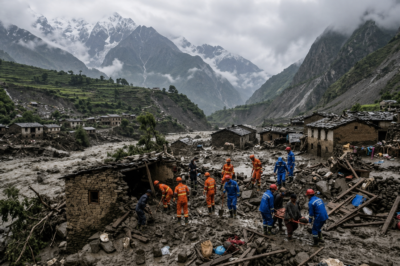
The Himalayan region is confronting a devastating humanitarian emergency as torrential monsoon rains, flash floods and massive landslides wreak havoc across Nepal and adjoining areas of China. The disaster has left hundreds dead or missing, destroyed homes and infrastructure, and isolated communities in some of the most difficult terrain in the world.
The scale of destruction has transformed the annual monsoon from a vital source of water into a deadly threat for thousands living in vulnerable mountain settlements. Rescue agencies are facing enormous challenges as blocked roads, unstable slopes, damaged bridges and continuing bad weather restrict access to affected areas.
A Humanitarian Crisis in the Mountains
The reported casualties have been accompanied by widespread destruction of homes, agricultural land, roads and public infrastructure. Remote villages have been particularly vulnerable, with many communities lacking reliable early-warning systems and all-weather transportation.
The economic consequences are also severe. Damage to highways and bridges has disrupted the movement of people, food and essential supplies. Cross-border trade routes connecting Nepal with China have also been affected, while losses of livestock and crops threaten the livelihoods and food security of rural families.
For survivors, the crisis extends well beyond the immediate disaster. Thousands face the prospect of spending weeks or months in temporary shelters while attempting to rebuild homes and livelihoods.
Nepal and China Step Up Rescue Efforts
The emergency has also underscored the importance of cooperation between Nepal and China. Search-and-rescue teams, helicopters, engineering units and surveillance equipment are being deployed to reach isolated communities and clear critical transportation routes.
The transboundary nature of Himalayan rivers makes coordination particularly important. Landslides can block waterways and create temporary natural dams, potentially triggering sudden downstream flooding if those barriers collapse.
Drones and other modern technologies can play an increasingly important role in identifying blocked roads, unstable slopes and stranded populations in areas where conventional rescue operations are extremely difficult.
Climate Change Adds a New Dimension
Scientists and environmental experts have repeatedly warned that climate change is altering the Himalayan environment. Rising temperatures are accelerating glacier and snow melt, while changing precipitation patterns can produce intense rainfall over short periods.
The combination of fragile mountain slopes, extreme rainfall and expanding glacial lakes increases the risk of floods and landslides. Glacial Lake Outburst Floods, or GLOFs, are another growing concern for communities living downstream of vulnerable high-altitude lakes.
While individual floods cannot automatically be attributed to climate change, a warming climate can increase the conditions that make extreme events more dangerous.
Infrastructure Under Pressure
The destruction of roads and bridges has exposed the vulnerability of mountain infrastructure. Poor drainage, unplanned construction and road cutting on steep slopes can increase the risk of landslides during intense rainfall.
The disaster therefore raises a larger question about the future of development in the Himalayas. Reconstruction cannot simply mean replacing what was destroyed. Roads, bridges, hydropower projects and settlements must increasingly be designed to withstand more extreme weather conditions.
Experts and policymakers are likely to face growing pressure to strengthen building standards, improve drainage, protect river corridors and restrict construction in highly vulnerable zones.
Relief Efforts Face a Race Against Time
For displaced families, the immediate requirements remain basic but urgent: safe drinking water, food, medicines, sanitation facilities, temporary shelter and emergency communications.
The difficult terrain makes conventional relief operations expensive and slow. Helicopters can reach isolated communities, but their capacity is limited, while damaged roads make large-scale ground transportation difficult.
The psychological impact should also not be overlooked. Families that have lost relatives, homes and livelihoods will require long-term social and economic assistance even after the floodwaters disappear.
Disaster Diplomacy in a Geopolitically Sensitive Region
The Himalayan disaster demonstrates that environmental threats do not respect political boundaries. Nepal, China and India share interconnected river systems and ecosystems, making regional cooperation essential.
The crisis could provide an opportunity to strengthen mechanisms for exchanging rainfall data, issuing flood warnings, monitoring glaciers and coordinating emergency responses. A regional disaster-management framework could prove increasingly valuable as extreme weather events become more frequent and unpredictable.
A Warning for the Future
The immediate priority is to save lives, locate missing people and provide assistance to survivors. But once the emergency subsides, governments will have to confront the deeper lessons of the disaster.
The Himalayas are among the world’s most environmentally fragile regions. Rapid infrastructure development, population pressure and changing climatic conditions are creating new risks for communities already exposed to natural hazards.
Rebuilding must therefore be accompanied by better planning, stronger early-warning systems, climate-resilient infrastructure and closer transboundary cooperation.
The tragedy unfolding across the Himalayan region should not be remembered merely as another devastating monsoon. It should serve as a warning that development and disaster preparedness must advance together. The real test of recovery will not be how quickly damaged roads and bridges are rebuilt, but whether the region becomes safer and more resilient before the next extreme-weather event arrives.
Editor’s note: The casualty figures and specific operational details in the supplied material should be independently verified against official Nepalese, Chinese and international disaster-agency sources before publication, particularly if the article is presented as a current breaking-news report.






Leave a Reply