
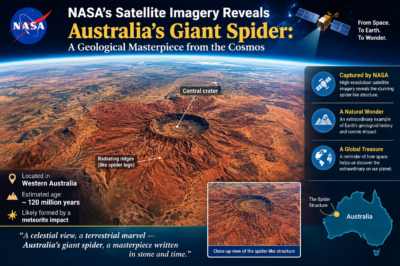
A remarkable satellite image of Australia’s remote Outback has drawn attention to an unusual geological formation resembling a gigantic spider. Captured through advanced Earth-observation technology, the structure highlights the extraordinary patterns that natural forces can create over millions of years. Although its appearance may suggest a giant creature, the formation is geological in origin and is associated with the ancient Tnorala, also known as Gosses Bluff, impact structure in Australia’s Northern Territory.
Scientists believe that Tnorala was formed approximately 142 million years ago when a large celestial object struck the Earth. The tremendous force of the impact created a vast crater, which was subsequently reshaped by erosion, wind and water. Over time, the more resistant rocks remained elevated while the surrounding landscape gradually wore away. The resulting circular hills, radiating ridges and drainage channels contribute to the unusual spider-like appearance visible from above.
NASA’s Landsat satellite programme plays an important role in observing such formations. Equipped with sophisticated imaging instruments, Landsat satellites help researchers examine variations in rock composition, soil conditions and surface features. These observations support geological mapping and provide valuable information about how landscapes evolve over time.
Beyond its scientific importance, the site holds deep cultural significance for the Western Arrernte people, the traditional custodians of the region. Known to them as Tnorala, the formation is connected with an important Dreamtime story involving a baby who fell from the Milky Way in a wooden basket. According to this traditional account, the basket became the circular rock formation. The story reflects the community’s enduring spiritual connection with the land and the sky.
Studying ancient impact structures also helps scientists understand similar formations on the Moon, Mars and other planetary bodies. Since Earth’s surface is continually altered by erosion and other geological processes, surviving impact sites offer valuable clues about the planet’s distant past and its encounters with objects from space.
The spider-like landscape of Australia therefore represents much more than an unusual natural spectacle. It brings together geological history, modern satellite technology and Indigenous cultural heritage. Continued satellite observation can help researchers monitor environmental changes and deepen our understanding of Earth’s evolving surface, revealing how the forces of nature have shaped the planet across immense stretches of time.






Leave a Reply