
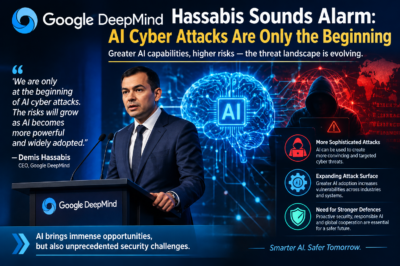
The rapid advancement of artificial intelligence has created remarkable opportunities while introducing serious cybersecurity challenges. Sir Demis Hassabis, co-founder and CEO of Google DeepMind, has reportedly described recent high-profile AI-related cyber incidents as “early warning shots,” highlighting the urgent need to strengthen digital security before emerging threats become more damaging.
The growing use of generative AI and autonomous systems is transforming the nature of cybercrime. Advanced AI tools can help attackers identify software weaknesses, automate malicious activities and develop highly convincing phishing messages. Deepfake audio and other forms of manipulated content also increase the risk of fraud and impersonation, potentially undermining public trust in digital communication.
These developments have raised concerns about the security of critical infrastructure, financial networks, healthcare databases and government systems. As businesses increasingly integrate AI into their operations, their exposure to cyberattacks may expand. Organisations must therefore treat cybersecurity as a fundamental requirement rather than an additional operational expense.
For technology companies, the challenge is twofold: developing increasingly capable AI systems while ensuring that these technologies cannot easily be exploited for harmful purposes. The same advances that support scientific research, healthcare and innovation may also be misused to discover software vulnerabilities or facilitate sophisticated attacks. Experts consequently emphasise rigorous testing, adversarial assessments and the development of AI-based defensive systems.
The changing threat landscape also has implications for investors and businesses, as demand for advanced cybersecurity solutions continues to grow. Companies may need to increase spending on secure infrastructure, continuous monitoring and stronger access controls to protect sensitive information and maintain customer confidence.
Government action and international cooperation are equally important. Since cyberattacks can cross national borders within seconds, isolated regulatory measures may not be sufficient. Greater coordination among governments, technology companies and security experts could help establish common safety standards and improve the early detection of AI-driven threats.
Ultimately, the reported warnings underline the importance of preparing for the risks accompanying technological progress. By combining responsible AI development, stronger cybersecurity measures and international cooperation, society can reduce the likelihood of serious digital disruptions while continuing to benefit from artificial intelligence. The priority is to act before emerging threats develop into major crises.






Leave a Reply