
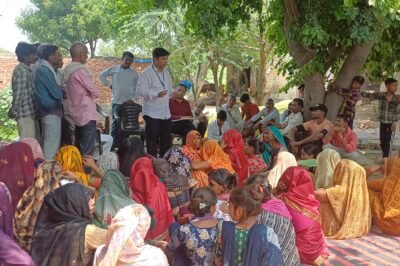
Design and Technical Development Workshop at Purdil Nagar, Hathras, Promotes Skill Development, Social Inclusion and Direct Market Linkages
India’s handicrafts sector represents an extraordinary combination of traditional knowledge, artistic excellence, cultural identity and inherited craftsmanship. However, changing consumer preferences, technological advancement and increasing competition have made design innovation, product diversification, quality improvement and effective marketing essential for the sustainable development of artisan communities.
Recognising these challenges, the Office of the Development Commissioner (Handicrafts), Ministry of Textiles, Government of India, has introduced the Skill Development in Handicraft Sector sub-scheme, comprising Design and Technology Development Workshops, Guru Shishya Hastshilp Prashikshan Programmes, Comprehensive Skill Upgradation Programmes and Improved Toolkit Distribution Programmes.
The Design and Technical Development Workshop component particularly focuses on developing innovative, market-oriented prototypes by combining traditional motifs, indigenous skills, contemporary designs and appropriate material combinations. Under the guidance of professional designers and Master Craftspersons, participating artisans receive practical exposure to emerging market trends and opportunities for value addition.
Before organising a workshop, the designer undertakes a cluster-level survey to assess existing craftsmanship, locally available resources, production capacity, market potential and prevailing designs. Based on these findings, new product concepts are developed in consultation with artisans, Master Craftspersons and the concerned Assistant Director (Handicrafts). The selected prototypes are subsequently developed during the workshop, enabling artisans to adopt improved designs for commercial production.
HSC Agra’s Initiative for Glass Bead Artisans
In this direction, Handicrafts Service Centre (HSC), Agra, has undertaken an important initiative by organising a Design and Technical Development Workshop under a Pilot Project on Glass Beads at Purdil Nagar, Hathras, Uttar Pradesh, from 3 to 30 October 2026.
A particularly commendable feature is the inclusion of artisans belonging to Scheduled Caste communities. The initiative seeks to extend developmental opportunities to artisans who may otherwise face social and economic barriers, reflecting the constitutional principles of equality, inclusion and equitable access to livelihood opportunities.
Beyond prototype development, HSC Agra is facilitating direct interaction between participating artisans and bulk buyers, exporters, corporate houses and private entrepreneurs. By inviting prospective buyers to the workshop itself, the Centre is creating opportunities for face-to-face discussions, product demonstrations, business enquiries and potential marketing arrangements without unnecessary dependence on intermediaries.
The proactive involvement of the Assistant Director (Handicrafts), HSC Agra, in buyer mobilisation and coordination deserves appreciation. Such efforts can help artisans understand commercial requirements, negotiate directly with purchasers and gradually develop independent enterprises.
Linking Skill Development with Government Support and Market Opportunities
The role of Handicrafts Service Centres extends beyond organising training programmes. They also guide artisans regarding entrepreneurship, financial assistance, institutional support and marketing opportunities available through various government initiatives.
The PEHCHAN Artisan Identity Card, issued through the Office of the Development Commissioner (Handicrafts), serves as an important means of artisan identification and can facilitate access to eligible government-supported programmes. Awareness regarding MUDRA loans, MSME-related assistance and participation in handicraft marketing events can further strengthen the economic prospects of participating artisans.
Subject to applicable scheme provisions and eligibility, support for exhibition stalls and travel-related expenses can also help artisans participate in marketing events beyond their immediate localities.
Agra’s Tourism and Handicraft Potential
Agra possesses enormous opportunities for integrating traditional handicrafts with tourism-based marketing. Renowned internationally for the Taj Mahal, Agra Fort and its rich cultural heritage, the city attracts millions of domestic and foreign visitors annually.
According to the tourism figures cited for 2024–25, the Taj Mahal received approximately 6.9 million visitors, including domestic and international tourists. This substantial tourist movement presents an opportunity to promote locally manufactured handicrafts through organised craft markets, product demonstrations and direct artisan–visitor interactions.
Agra is already recognised for marble inlay, stone carving, Zari-Zardozi embroidery, glassware, carpets and other traditional crafts. However, the full economic potential of these artistic traditions can be better realised through improved infrastructure, innovative product development, branding and organised market access.
There is considerable scope for establishing a dedicated Urban Haat or Crafts Village in Agra, supported by a sustainable business model, appropriate visitor facilities, live craft demonstrations, cultural activities and year-round marketing opportunities.
A well-planned craft destination, drawing inspiration from established events such as the Surajkund International Crafts Mela, could provide artisans with direct access to tourists, reduce dependence on intermediaries and strengthen the identity of Agra as both a heritage tourism centre and a handicraft destination.
From Traditional Craftsmanship to Sustainable Enterprise
The Design and Technical Development Workshop at Purdil Nagar demonstrates how institutional support, design expertise, inclusive participation and direct buyer engagement can collectively contribute to artisan empowerment.
Its long-term success will depend upon the commercial adoption of newly developed prototypes, sustained buyer relationships, improved production capacity and continued institutional guidance.
The initiative undertaken by HSC Agra under the Office of the Development Commissioner (Handicrafts) reflects an important approach towards transforming skilled artisans into self-reliant entrepreneurs while preserving traditional craftsmanship.
When traditional skills are strengthened through innovation, supported by effective market linkages and connected with tourism opportunities, handicrafts can become a powerful instrument of employment generation, social inclusion and sustainable economic development.
The ultimate objective should be not merely to train artisans, but to enable them to establish successful enterprises, secure regular orders, earn dignified livelihoods and contribute meaningfully towards the vision of Atmanirbhar Bharat and Viksit Bharat.






Leave a Reply