
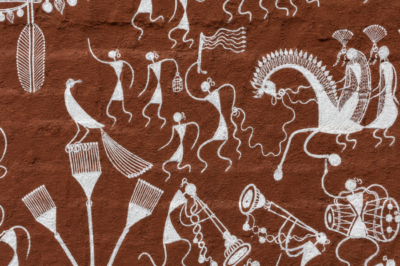
From the mud walls of Maharashtra’s tribal homes to contemporary interiors, Warli art continues to preserve an ancient worldview through an extraordinary language of geometry and symbolism.
In a world increasingly dominated by digital design, artificial intelligence and rapidly changing artistic trends, Warli painting remains a striking reminder that great art does not always require complexity. Sometimes, a circle, a triangle and a few carefully placed lines are enough to tell an entire story.
Rooted in the tribal communities of Maharashtra, Warli painting is far more than a decorative folk-art tradition. It is a visual record of community life, agricultural cycles, spiritual beliefs, celebrations, relationships and the enduring bond between human beings and nature. Every figure and pattern carries meaning, turning an apparently simple composition into a sophisticated cultural narrative.
An Art Born From the Landscape of Maharashtra
The Warli community is largely associated with the Dahanu and Jawhar regions of Palghar district in Maharashtra, in the Sahyadri hill region north of the Western Ghats. Traditionally, Warli communities have depended heavily on agriculture, forest produce and livestock.
Their lives have therefore always been closely connected with the natural environment. Agriculture, seasonal changes, forests, animals, rainfall and the cycles of cultivation are not merely subjects in Warli art—they form the foundation of the worldview expressed through it.
This intimate relationship with nature gives Warli painting a distinctive spiritual character. Nature is regarded with reverence, and forces associated with different seasons occupy an important place in the community’s belief system. At the centre of this cultural relationship stands the Mother Goddess, whose presence is closely connected with fertility, protection and the continuity of life.
When Mud Walls Became Canvases
Long before art galleries and designer décor entered the picture, the walls of Warli homes served as the canvas.
The traditional process was remarkably simple and deeply connected to the materials available in the surrounding environment. The walls were coated with cow dung and red mud to create the background. A white pigment was prepared from rice, while pointed twigs and bamboo served as drawing instruments.
The result was a visually distinctive contrast: white figures and patterns emerging from an earthy red-brown surface.
Yet the apparent simplicity of the technique should not be mistaken for artistic limitation. Within these basic materials, Warli artists developed an elaborate visual vocabulary capable of representing ceremonies, agriculture, animals, human relationships and spiritual beliefs.
Geometry That Tells Stories
Perhaps the most fascinating feature of Warli art is its geometric language.
Circles, triangles and squares are not merely shapes—they function as symbols. Circles can evoke celestial bodies, triangles suggest mountains and trees, while squares can represent settlements or sacred spaces. These forms are brought together to create elaborate scenes of everyday life.
Human figures are often created using two connected triangles, producing an unmistakable Warli silhouette. Despite their simplicity, these figures can express movement, celebration, labour and emotion.
A group of dancers can appear to move in rhythm. Farmers can be shown working in the fields. Animals can seem to run through the composition. Trees, streams and rocks help create a complete natural environment.
It is this combination of minimalism and meaning that has allowed Warli painting to remain visually powerful even for modern audiences.
The Forest, Animals and the Rhythm of Life
Nature occupies a central position in Warli compositions.
Trees are depicted with particular care because of their importance to the community’s livelihood. Birds, squirrels, monkeys, snakes and other animals appear in active poses, giving the paintings movement and vitality. Streams, rocks and other elements of the landscape complete the visual environment.
The paintings therefore do not present human beings as separate from nature. Instead, people, animals, vegetation and the wider environment appear as interconnected parts of one living system.
That idea feels particularly relevant today, when conversations about sustainability, ecological balance and humanity’s relationship with nature have become increasingly important.
More Than a Picture: The Spiritual Meaning of Warli Art
One of the most profound aspects of Warli painting is that the completed artwork is not necessarily regarded as permanent.
Traditionally, paintings were created for specific ritual or spiritual occasions and could fade or be erased after the worship associated with them. This suggests that the act of creating the painting itself was as important as the finished image.
The philosophy behind this practice reflects a broader understanding of life’s temporary nature.
The painting appears, fulfils its ritual purpose and eventually disappears—much like the cycles of nature and human existence.
In this sense, Warli art challenges the modern obsession with permanence. Its value lies not simply in possessing an object, but in participating in a cultural and spiritual process.
The Sacred Square and the Goddess of Fertility
Among the most important forms in Warli tradition is the chowk, particularly the marriage-related painting.
Marriage paintings are deeply significant within Warli society. The ritual artwork is considered essential to the wedding ceremony and is created with elaborate squares and concentric designs. At its centre appears the Goddess of Fertility, while other elements—including plants, animals and the wedding procession—surround the sacred composition.
The square itself carries profound symbolism.
Known as the cauk, it creates a sacred visual space around the central goddess, while the smaller deva cauk contains another important figure. The surrounding foliage provides an additional layer of symbolism and visual richness.
Thus, a wedding painting is not merely an illustration of a marriage. It represents fertility, creation, family, nature and the continuation of life.
Marriage as a Cosmic Celebration
For the Warlis, marriage traditionally carries a significance far beyond the union of two individuals.
The marriage season forms part of the annual ritual cycle and is associated with the renewal of creative and fertile forces in nature. The ceremony, therefore, is understood as an event connected to the wider universe and the continuation of life.
The preparation of the painting itself becomes a communal activity. Women create the sacred square and central goddess, while other elements such as trees, animals and human figures are added around it.
The result is a visual universe surrounding the wedding ceremony.
The Tarpa Dance: Movement Captured in Lines
Another instantly recognizable theme of Warli art is the Tarpa dance.
During Diwali celebrations, dancing and music form an important part of the community’s festivities. Dancers gather in an open space around the Tarpa player, moving according to the rhythm and direction of the instrument.
Warli artists translate this movement into visual form.
Rows and circles of stylised human figures create the impression of a dance continuing beyond the boundaries of the painting. The arrangement gives the artwork a rhythm of its own.
In this way, Warli painting achieves something remarkable: it makes still images appear to move.
Harvest, Ritual and Gratitude
Agriculture is another central theme.
The Warli agricultural cycle traditionally begins with the arrival of the rains and progresses through planting and harvesting. Seasonal festivals such as Cheda Puja and celebrations associated with the Tiger God and Corn Goddess reflect the community’s gratitude for agricultural abundance and its dependence on natural forces.
The visual traditions surrounding these occasions demonstrate how closely art, agriculture and spirituality are woven together.
Tools of cultivation and domestic implements can also receive auspicious designs, transforming ordinary objects into carriers of cultural meaning.
Even Death Is Viewed Through the Cycle of Life
Warli philosophy also offers a distinctive perspective on death.
Rather than viewing death solely as an ending, the tradition connects it with another beginning and observes rituals that bear similarities to those associated with marriage. The community’s broader spiritual framework remains closely tied to nature, ancestral spirits and the forces believed to govern existence.
This perspective reinforces one of the central ideas running through Warli art: life exists within cycles rather than isolated moments.
Birth, marriage, agriculture, festivals, nature and death are all part of the same larger continuum.
The Women Who Preserved the Tradition
Warli painting has historically been closely associated with women of the community.
Traditional paintings were created by suvasinis, with dhavaleris—married priestesses—singing alongside them and contributing to the ceremonial atmosphere. The content and style of the paintings could vary depending on the occasion and the deity being honoured.
This makes Warli painting not simply an artistic practice but also a form of intergenerational cultural transmission.
Knowledge passed from one generation to another through practice, ritual and community participation allowed the visual language to survive for generations.
From Tribal Walls to Contemporary Homes
The journey of Warli art does not end with traditional village walls.
In recent times, its distinctive visual motifs have moved into contemporary homes and commercial markets. Warli-inspired designs can now be seen on wall hangings, tableware, cushions and other home décor products, showing how an indigenous art form can adapt to changing consumer preferences while retaining its cultural identity.
This transition presents both an opportunity and a responsibility.
The growing popularity of Warli art can create new markets and income opportunities for traditional artisans. At the same time, preserving the authenticity and cultural meaning of the art remains essential.
Commercial success should not come at the cost of cultural identity.
Why Warli Matters in Modern India
Warli painting offers an important lesson for contemporary India.
At a time when design is increasingly driven by technology and global trends, Warli demonstrates the enduring power of indigenous knowledge. Its visual vocabulary is minimal, but its stories are immense.
A few geometric forms can communicate ideas about fertility, community, spirituality, agriculture, celebration and the environment.
That is why Warli painting should not be viewed simply as an attractive handicraft.
It is a visual archive of tribal life—a record created through symbols rather than written documents.
Every line carries memory. Every pattern reflects a belief. Every figure connects the present with generations that came before.
Preserving a Heritage While Creating a Future
The continued popularity of Warli painting demonstrates that traditional art can remain relevant in a modern economy.
But its survival depends on more than consumer interest. Traditional artisans need recognition, sustainable markets and opportunities to pass their skills to younger generations.
The challenge is to create a balance between commercial adaptation and cultural preservation.
When achieved successfully, such a balance can turn handicrafts into sustainable livelihoods while ensuring that indigenous artistic traditions remain alive.
Warli art offers an especially powerful example because its visual language is immediately accessible even to people unfamiliar with its cultural origins.
Its simplicity attracts the eye.
Its symbolism invites curiosity.
And its stories create a connection.
A Story That Refuses to Fade
Warli painting has travelled a remarkable distance—from the walls of tribal homes in Maharashtra to modern décor, exhibitions and contemporary design spaces.
Yet its fundamental message remains unchanged.
It continues to speak about people, nature, community, fertility, celebration, work and the mysteries of life.
Perhaps that is the greatest strength of Warli art.
It does not need elaborate colours or complicated techniques to command attention. Its power comes from the confidence of simplicity and the depth of the stories hidden within it.
From a humble mud wall to the modern interior, Warli painting has shown that an ancient visual language can remain remarkably alive in a changing world.
Its circles still echo the universe.
Its triangles still evoke the landscape.
Its dancing figures still celebrate community.
And its simple white lines continue to tell stories that generations have carried forward.
Warli painting is not merely art from the past. It is a living conversation between heritage, nature and humanity—and its story is still being written.





Leave a Reply