
The Office of the Development Commissioner (Handicrafts), Ministry of Textiles, Government of India, is implementing flagship schemes such as MSS, AHVY (Cluster Development Scheme), SDHS, Welfare/Direct Benefit Scheme and Research & Development Scheme for the overall development and welfare of artisans across the country. Before implementing these programmes, the field offices undertake detailed exercises to identify genuine artisans, suitable craft clusters, local resources, production potential and the socio-economic conditions of artisan communities, ensuring that government support reaches the deserving beneficiaries.
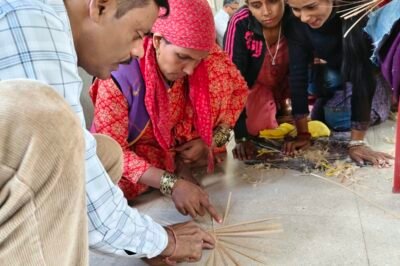
In this context, Handicrafts Service Centre (HSC), Kullu, Himachal Pradesh, identified a cluster at Kalang Village for implementation of a Design & Technology Workshop, with the objective of developing contemporary designs in accordance with changing market trends and creating greater commercial opportunities for local artisans.
The workshop brought together reputed designers and master craftspersons who worked closely with local artisans to introduce new designs, craft fusion, value addition and improved product concepts. Initially, 30 artisans were selected for participation. However, the programme encountered several local social and cultural challenges. On the following day, only 15 artisans reported, reportedly due to a local misconception that participation in the workshop could lead to changes in their caste identity, locally referred to as “virus”. Considerable efforts were made to clarify the misunderstanding and build confidence among the community, ultimately enabling the batch to continue successfully.
The programme also had to accommodate deeply rooted local social customs. In particular, traditional practices concerning menstruation meant that women observing their menstrual period sometimes remained separately from the main workshop area. The programme was conducted with sensitivity towards these practices while maintaining its focus on artisan participation and learning.
The workshop further faced unexpected practical difficulties, including the death of an elderly village resident, which led to the observance of a day of mourning and suspension of work. A prolonged power outage in the village also created operational challenges.
Despite these hurdles, the enthusiasm and willingness of the artisans to learn were highly encouraging. Their active participation and eagerness to experiment with new designs demonstrated the immense potential of the cluster.
The successful organisation of the workshop reflects the dedication and field-level commitment of HSC Kullu and the organising team, who continued their efforts despite social, cultural and infrastructural constraints. The initiative is particularly significant because the artisans possess considerable skills for producing distinctive handcrafted products with strong commercial potential.
With appropriate design intervention, quality improvement, value addition and professional marketing, these products could attract bulk buyers, exporters, corporate houses and institutional markets beyond Himachal Pradesh. The next important step would be to provide these artisans opportunities to participate in national-level exhibitions, craft bazaars and appropriate commercial platforms, enabling them to directly experience larger markets and understand consumer preferences.
Such exposure can gradually transform traditional craftsmanship into a sustainable livelihood and commercially viable profession. More importantly, successful market linkage and improved earnings may encourage the younger generation to continue and strengthen their traditional craft heritage as a dignified profession, ensuring that the skills and cultural identity of the community are preserved for future generations.





Leave a Reply