
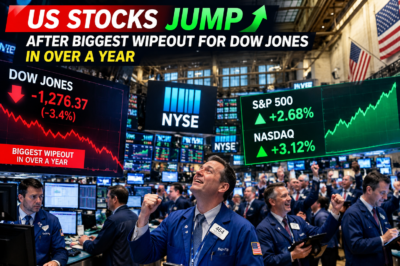
The United States stock market experienced significant turbulence as Wall Street staged an impressive recovery following a steep decline in the Dow Jones Industrial Average, which reportedly lost more than 1,000 points during a single trading session. The dramatic turnaround highlighted the unpredictable nature of financial markets and the continuing influence of economic developments on investor sentiment.
The initial market downturn was largely associated with renewed concerns over inflation, uncertainty surrounding the Federal Reserve’s interest rate policies and disappointing earnings expectations from major corporations. Investors became increasingly cautious about the possibility of borrowing costs remaining elevated for an extended period, potentially affecting business expansion, consumer expenditure and overall economic growth.
The selling pressure extended across several important sectors, including technology, healthcare, energy and financial services. Institutional investors reportedly reassessed their portfolios, while heightened market volatility encouraged many traders to reduce their exposure to equities.
However, the following trading session witnessed a notable change in sentiment. Investors began purchasing shares that had become relatively attractive after the sharp decline, demonstrating the familiar market strategy of buying stocks during temporary corrections.
Leading technology companies played an important role in supporting the recovery. Businesses associated with artificial intelligence, semiconductor production, cloud computing and other emerging technologies attracted renewed investment interest because of their perceived long-term growth potential.
Consequently, major American stock indices, including the Dow Jones, S&P 500 and Nasdaq Composite, reportedly registered encouraging gains. Corporate share repurchase initiatives and expectations of continued profitability further strengthened market confidence.
The developments also influenced financial markets beyond the United States. European and Asian exchanges reacted to the fluctuations on Wall Street, demonstrating how closely international investment flows and economic expectations are interconnected.
Nevertheless, the recovery does not necessarily indicate that the underlying economic challenges have disappeared. Persistent inflationary pressures, future Federal Reserve decisions, corporate earnings performance and changing global economic conditions could continue to generate uncertainty.
Financial analysts therefore remain divided over whether the rebound represents the beginning of a sustained upward movement or simply a temporary recovery following excessive selling.
The episode also reinforces the importance of maintaining a balanced investment approach. Investors should carefully evaluate company fundamentals, financial stability, earnings prospects and long-term business potential instead of making decisions based entirely on short-term market movements.
The recent Wall Street fluctuations offer an important lesson about the relationship between economic uncertainty, investor psychology and market resilience. While sudden declines can create widespread concern, recoveries may emerge when investors regain confidence in the underlying strength of businesses and the broader economy.
Ultimately, sustainable market growth will depend on economic stability, responsible monetary policies, corporate performance and continued investor confidence in future opportunities.






Leave a Reply