
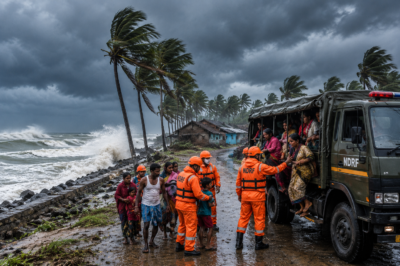
Cyclone Remal, which developed over the Bay of Bengal in May 2024, posed a serious threat to the coastal regions of West Bengal and Bangladesh, highlighting the increasing vulnerability of densely populated coastal areas to severe weather events.
Originating from a low-pressure system over the Bay of Bengal, the disturbance gradually intensified into a severe cyclonic storm. According to forecasts issued by the India Meteorological Department (IMD), the cyclone was expected to make landfall on the night of May 26, 2024, between Sagar Island in West Bengal and Khepupara in Bangladesh, with wind speeds reaching approximately 110–120 kilometres per hour and gusts up to 135 kilometres per hour.
The coastal districts of North and South 24 Parganas and East Midnapore in West Bengal, along with Satkhira, Khulna and Bagerhat in Bangladesh, faced considerable risks from powerful winds, torrential rainfall and rising seawater levels.
The ecologically sensitive Sundarbans, recognised globally for its extensive mangrove forests, was particularly vulnerable to storm surges, flooding and saltwater intrusion. Such disturbances threaten not only biodiversity but also the livelihoods of communities dependent on agriculture, fishing and aquaculture.
The cyclone also raised concerns about damage to electricity networks, telecommunications, transportation systems, residential buildings and essential public infrastructure. Agricultural activities, including paddy cultivation, betel leaf farming and shrimp production, faced potential economic losses.
In anticipation of the storm, disaster management authorities in India and Bangladesh initiated preventive measures, including evacuation arrangements, emergency shelters, deployment of rescue personnel and public awareness campaigns.
The National Disaster Response Force, Indian Coast Guard and other emergency agencies prepared to undertake rescue and relief operations, while local administrations coordinated the distribution of essential supplies.
Beyond its immediate consequences, Cyclone Remal demonstrated the growing importance of climate resilience. Rising ocean temperatures can provide additional energy for tropical cyclones, increasing concerns about severe storms and their potential impact on coastal populations.
The recurring threat of cyclones such as Amphan, Yaas and Remal underscores the necessity of strengthening coastal embankments, restoring mangrove ecosystems, improving early-warning systems and developing disaster-resistant infrastructure.
Greater cooperation between India and Bangladesh is equally important for protecting vulnerable communities along their shared coastal environment.
Cyclone Remal serves as a powerful reminder that disaster preparedness must extend beyond emergency rescue operations. Long-term environmental protection, scientific forecasting, resilient infrastructure and community participation are essential for safeguarding human lives, preserving livelihoods and ensuring sustainable development in cyclone-prone regions.






Leave a Reply