
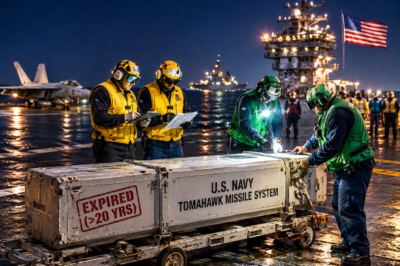
A surprising revelation surrounding the United States military’s Operation Epic Fury has triggered an international debate over defence preparedness, weapons reliability and the growing challenges of modern warfare. Reports indicate that the US Navy deployed certain missiles that had technically exceeded their manufacturer-rated shelf life, raising questions about the operational readiness of one of the world’s most powerful military forces.
The controversy intensified after a senior US Navy officer reportedly compared the expired missiles to ‘stale bread’, suggesting that crossing the official expiry date does not necessarily mean that the weapons have become unusable. Although the comparison attracted considerable public attention, the underlying issue involves complex engineering assessments and the reliability of ageing military equipment.
Modern guided missiles contain sophisticated electronic guidance systems, rocket motors, thermal batteries and explosive components, all of which can deteriorate over time. However, through Service Life Extension Programmes (SLEPs), military authorities can test, refurbish and extend the operational life of older weapons when their performance meets prescribed safety and reliability standards.
The decision also highlights financial and logistical pressures within the American defence industry. Manufacturing advanced cruise missiles involves substantial expenditure, specialised components and lengthy production cycles. Rising raw-material costs, supply-chain disruptions and the depletion of existing stockpiles due to multiple international conflicts have further complicated replenishment efforts.
Strategically, the deployment of older munitions sends a mixed message to potential adversaries, particularly Iran. While it demonstrates America’s ability to utilise available military resources, it may also invite scrutiny of its weapons inventory and long-term operational preparedness.
Ultimately, the ‘stale bread’ controversy is more than a debate over expired missiles. It highlights the importance of maintaining reliable defence stockpiles, strengthening domestic manufacturing capabilities and investing in affordable next-generation weapons. In modern warfare, technological superiority must be supported by adequate inventory, dependable equipment and sustainable defence production.







Leave a Reply