
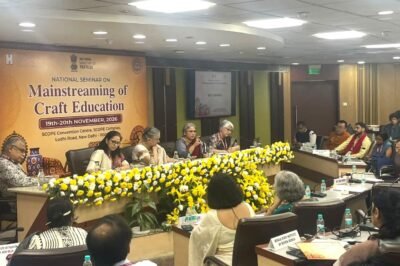
1st Day –
The Office of the Development Commissioner (Handicrafts), Ministry of Textiles, Government of India, organised a significant two-day National Seminar on “Mainstreaming of Craft Education in Higher Education” on 19th–20th November 2026 at the CGO Complex, New Delhi. The initiative marked an important step towards integrating India’s rich traditional craftsmanship, indigenous knowledge and cultural heritage into the formal higher education system.
The seminar was inaugurated by Smt. Neelam Shami Rao, Secretary, Ministry of Textiles, in the august presence of Ms. Amrit Raj, Development Commissioner (Handicrafts); Smt. Rita Menon, IAS (Retd.), Former Secretary, Ministry of Textiles and President, AIWEFA; and other distinguished dignitaries and representatives of leading educational institutions from across the country. Addressing the gathering, Smt. Neelam Shami Rao emphasised the importance of systematically documenting, preserving and transmitting India’s diverse craft traditions to future generations. She highlighted the need to develop innovative academic curricula that connect traditional craftsmanship with contemporary education, enabling students and young learners to appreciate, understand and carry forward India’s invaluable craft heritage and cultural legacy.
The seminar brought together eminent academicians, institutional heads, researchers and craft education experts to deliberate on integrating craft-specific learning into higher education through experiential learning, industry-oriented programmes, design innovation, technology, sustainability and entrepreneurship. Session II – Curriculum Planning & Implementation, chaired by Prof. Neeraj Gupta, Academic Advisor, IICD, Jaipur, explored the development of structured, craft-specific and industry-aligned academic programmes. Experts representing institutions from Andhra Pradesh, Himachal Pradesh, Telangana, Jammu & Kashmir and Madhya Pradesh shared valuable perspectives on curriculum development and implementation. Session III – Resource Management & Infrastructure, chaired by Mr. Nishit Sangomla, Director, Somaiya Kala Vidya, Kutch, Gujarat, focused on the essential infrastructure, trained faculty, skilled human resources and institutional support required to establish sustainable craft education programmes.
A special appreciation is also due to the respective Regional Directors, whose active coordination with educational institutions across different regions helped bring diverse institutions onto a common national platform. Their dedicated efforts, under the supervision and guidance of Ms. Seema Mishra, ISS, Director (Handicrafts), played a crucial role in facilitating this important national initiative.
The seminar represents a meaningful bridge between India’s traditional knowledge systems and modern academic institutions. Craft education must go beyond preserving the past; it must create opportunities for innovation, dignified livelihoods and a sustainable future for India’s artisans and their invaluable heritage.
2nd Day-
The second day of the two-day National Seminar on “Mainstreaming of Craft Education in Higher Education”, organised by the Office of the Development Commissioner (Handicrafts), Ministry of Textiles, Government of India, witnessed engaging deliberations and enthusiastic participation from eminent intellectuals, renowned artists, researchers, academicians, associate professors, distinguished faculty members and representatives of reputed educational institutions from different parts of the country.
The deliberations on Day 2 marked a significant progression towards developing a comprehensive and sustainable approach for integrating India’s traditional craft knowledge into the mainstream higher education system. Representatives of participating universities and institutions shared their experiences, institutional initiatives and academic practices, highlighting the introduction and implementation of craft- and design-oriented programmes at Diploma, Undergraduate, Postgraduate and Ph.D. levels across diverse disciplines. These presentations reflected the growing recognition of traditional craftsmanship as an important field of academic learning, research, innovation and professional development.
The day’s proceedings revolved around three important thematic sessions, each addressing a critical dimension of the proposed national framework.
Session IV – Funding Mechanism & Financial Stability, chaired by Prof. (Dr.) Bindoo Ranjan, University School of Design and Innovation, GGSIPU, focused on developing sustainable financial models, institutional funding support, infrastructure development and outcome-based financing mechanisms to ensure the long-term viability of craft education programmes.
Session V – Artisan–Institute Interface, chaired by Prof. S.G. Ranjan, Design Educator and Craft Professional, emphasised the importance of establishing meaningful partnerships between traditional artisans, academic institutions and industry. The discussions highlighted experiential learning, practical exposure, skill development and the integration of indigenous craft knowledge into formal academic curricula. The underlying message was that artisans should not remain merely the custodians of traditional skills but should also become active contributors to the academic knowledge system.
Thematic Session VI – National Framework for Craft Education, chaired by Prof. Promil Pande, Dean, UID NCR Campus, GD Goenka University, explored institutional preparedness, student intake strategies, challenges in introducing craft-based curricula and appropriate implementation timelines across universities and higher education institutions. The discussions provided valuable perspectives towards developing a structured, inclusive and nationally adaptable framework.
The two-day seminar concluded with meaningful exchanges of knowledge, institutional experiences and constructive recommendations, laying an important foundation for mainstreaming craft education within India’s higher education ecosystem.
India’s traditional crafts represent centuries of accumulated knowledge, scientific understanding, artistic imagination and community-based wisdom. Bringing this invaluable heritage into universities and academic institutions will create opportunities to connect generations of traditional knowledge holders with young learners, designers, researchers and future entrepreneurs. It will also help establish stronger linkages between education, employment, innovation and the creative economy.
The larger vision is not merely to preserve traditional crafts as a part of our cultural heritage, but to transform them into a recognised stream of education, research, innovation and sustainable livelihood opportunities.
When traditional artisans share their knowledge with academic institutions, education becomes more meaningful; when young minds embrace traditional craftsmanship, heritage finds a new direction; and when knowledge meets creativity, India’s craft traditions become a powerful foundation for future generations.
“From Tradition to Education, From Heritage to Innovation – Empowering India’s Craft Future.”





Leave a Reply