
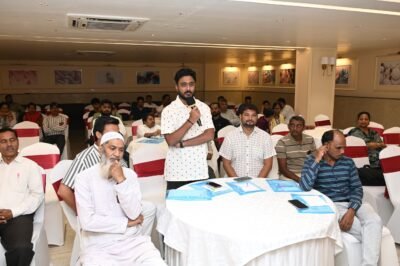
Bhopal, August 22, 2026: A significant seminar for Master Cluster Artisans (MCPs) was organised by the Office of the Development Commissioner (Handicrafts), Western Regional Office, Mumbai, under the jurisdiction of Handicrafts Service Centre (HSC), Bhopal, with a strong focus on empowering master craftspersons, resolving implementation challenges and creating new avenues for sustainable growth of India’s handicrafts sector.
Held at Tree, ISBT Bhopal, the programme brought together master craftspersons and officials from Goa, Madhya Pradesh, Maharashtra, Gujarat and Chhattisgarh, providing an important platform for interaction, knowledge-sharing and practical solutions to challenges faced in implementing various handicrafts programmes.
The programme was graced by Shri Rituraj Ranjan, Managing Director, MP State Cooperative Union, as Chief Guest, while Shri Akhil Sahay, Director, NIFT Bhopal, attended as Guest of Honour. Shri Deeptansu Haldar, Regional Director (Handicrafts), WRO Mumbai, along with senior officials including Ms. Arpana Deshmukh, Shri Kapil Sahu, Shri Manoj Rathi and Shri Archit Sahare, participated in the programme.
The event commenced with the traditional lamp lighting ceremony and felicitation of dignitaries, setting the tone for a day dedicated to strengthening India’s craft ecosystem.
Empowering Master Craftspersons Through Knowledge and Opportunity
In his address, Shri Deeptansu Haldar, Regional Director (Handicrafts), highlighted the evolving role of Master Cluster Artisans and stressed the importance of professional development, entrepreneurship and greater awareness about government initiatives. He elaborated on the role of GSHPP trainers, career progression, digital marketing, social-media promotion and the India Handmade Portal as important tools for transforming traditional craftsmanship into sustainable entrepreneurial activity.
He urged master craftspersons not merely to remain custodians of traditional skills but also to emerge as entrepreneurs, mentors and ambassadors of Indian handicrafts.
Shri Akhil Sahay, Director, NIFT Bhopal, emphasised India’s extraordinary craft diversity and the need for greater awareness among artisans. He highlighted the importance of artisan awareness camps, technical training, design intervention and stronger marketing platforms to bridge the gap between traditional craftsmanship and contemporary markets.
Chief Guest Shri Rituraj Ranjan stressed the importance of long-term collaboration and collective efforts to take Indian crafts towards world-class standards. Drawing upon experiences related to the CHCDS project and producer companies, he underlined the need for stronger institutional mechanisms and collective enterprise models that can enhance the economic position of artisans.
India Handmade Portal: Opening Doors to Global Markets
One of the major attractions of the seminar was the technical session on the India Handmade Portal, conducted virtually by Ms. Shefali Gupta and Shri Manoj Singh.
The session explained the registration process, product uploading, online selling and other features of the platform. The participants were encouraged to make active use of the portal as a digital marketplace capable of connecting artisans directly with customers beyond geographical boundaries.
The seminar particularly emphasised that digital platforms can provide artisans with an opportunity to showcase their products to national and international buyers, expand their customer base and develop sustainable business linkages.
Participants were also informed about the shift towards digital artisan identity cards, making it increasingly important for craftspersons to maintain updated digital profiles.
GI Awareness and Protection of Traditional Crafts
A dedicated technical presentation on Geographical Indications (GI) was delivered by Shri R.N. Devangan, who explained the legal significance of GI registration, the process of registration and the procedure for becoming an authorised GI user.
The session highlighted how GI recognition can help protect the identity, authenticity and traditional knowledge associated with distinctive Indian crafts while creating greater market visibility and consumer confidence.
Focus on Digital Compliance and Professionalisation
The seminar also identified several important compliances and activities for Master Cluster Artisans. Participants were advised to:
- Complete Udyam Aadhaar/Udyam registration as entrepreneurs within the prescribed timeline.
- Create professional Instagram and Facebook pages for their craft activities.
- Develop digital product catalogues and regularly create product reels.
- Maintain active and updated product listings on the India Handmade Portal.
- Document important programme activities and share them through appropriate social-media platforms to create public awareness about India’s crafts and craftsmanship.
The emphasis on documentation and digital storytelling was particularly significant. By systematically recording their activities, techniques, products and success stories, artisans can help create a stronger public understanding of India’s diverse craft traditions while simultaneously promoting their own enterprises.
Nine-Group Workshop Encourages Collective Problem-Solving
The programme adopted an interactive approach through a group task workshop, in which participating Master Trainers were divided into nine groups. The groups worked on practical issues relating to design innovation, trainer-related challenges and models for enhancing artisan incomes.
The exercise encouraged participants to move beyond conventional discussions and develop practical solutions based on their field experiences. Such peer-to-peer interaction provided valuable insights into the challenges faced by artisans across different States and regions.
The programme concluded with an interactive feedback session involving participants from Goa, Madhya Pradesh, Maharashtra, Gujarat and Chhattisgarh.
A Step Towards a Stronger Craft Economy
The seminar reflected the broader objective of the Office of the Development Commissioner (Handicrafts) to empower Master Craftspersons and strengthen the implementation of handicrafts development programmes at the grassroots level.
The discussions made it clear that the future of Indian handicrafts will depend not only on preserving traditional skills but also on innovation, entrepreneurship, digital visibility, market intelligence and professional business practices.
For the participating Master Craftspersons, the seminar offered an opportunity to understand how traditional skills can be converted into sustainable economic opportunities. The message emerging from the programme was simple yet powerful: Indian handicrafts can reach the world when artisans are equipped with the right skills, technology, platforms and market access.
The Bhopal seminar therefore marked an important step towards building a more confident, digitally connected and commercially sustainable community of Indian Master Craftspersons—one capable of carrying the country’s rich craft heritage from local communities to national and global markets.






Leave a Reply