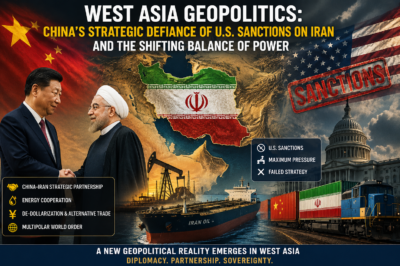
The geopolitical landscape of West Asia is undergoing a significant transformation as China increasingly challenges the United States’ approach towards Iran. Beijing has voiced strong opposition to Washington’s policy of unilateral sanctions and “maximum pressure,” arguing that economic coercion has failed to resolve the Iranian nuclear issue and has instead contributed to instability in an already volatile region.
China’s position reflects its broader effort to promote a more multipolar international order in which Western powers no longer exercise dominant influence over global diplomacy, trade and security. The growing alignment between Beijing and Tehran could have far-reaching consequences for regional stability, global energy markets, maritime security and the future of international efforts to address Iran’s nuclear programme.
From Sanctions to Strategic Competition
Relations between the United States and Iran have remained deeply strained since the 1979 Islamic Revolution. Washington has imposed successive rounds of economic restrictions, while the withdrawal of the United States from the 2015 Joint Comprehensive Plan of Action (JCPOA) intensified tensions.
The subsequent “maximum pressure” campaign was designed to isolate Iran economically and compel Tehran to make significant concessions. However, China has consistently criticised unilateral sanctions and argued that dialogue and diplomacy remain the most sustainable means of resolving disputes.
Beijing’s position has become increasingly significant because China possesses the economic capacity and strategic influence to maintain substantial engagement with Iran despite American pressure.
The China-Iran Partnership
A major pillar of this relationship is the 25-year Strategic Cooperation Agreement signed in 2021. The framework envisages deeper cooperation across areas including energy, infrastructure, telecommunications and economic development.
For Iran, stronger economic ties with China provide an important avenue for maintaining international trade and reducing dependence on Western markets. For Beijing, closer relations with Tehran offer access to energy resources and strengthen its strategic presence in West Asia.
Iran’s importance to China is particularly significant because of its vast oil and gas reserves. Continued energy cooperation also demonstrates the limitations of sanctions when major global powers are prepared to maintain commercial and strategic engagement with the targeted country.
Oil and the Global Energy Market
The China-Iran relationship has important implications for the global energy market. China is one of the world’s largest crude-oil importers, while Iran possesses substantial hydrocarbon resources.
Any disruption to Iranian oil exports could place additional pressure on international energy prices. Conversely, continued Iranian exports provide China with access to energy while helping Tehran generate much-needed revenue.
This creates a difficult strategic calculation for Washington. Stronger enforcement of secondary sanctions against Chinese companies could intensify tensions between the world’s two largest economies, while limited enforcement could weaken the credibility and effectiveness of the sanctions regime.
Iran’s Growing Engagement With Non-Western Institutions
Iran’s closer relationship with China is also reflected in its engagement with institutions associated with the emerging non-Western economic and security architecture.
Its participation in the Shanghai Cooperation Organisation (SCO) and involvement with BRICS provide Tehran with additional diplomatic and economic platforms outside traditional Western institutions.
China’s growing diplomatic role in the region has further enhanced its influence. Beijing’s mediation of the Saudi-Iran diplomatic rapprochement demonstrated that China is increasingly willing to play a direct role in resolving regional disputes.
The Nuclear Question Remains Unresolved
Despite opposing U.S. sanctions, China continues to support diplomatic efforts aimed at preventing nuclear proliferation. Beijing has repeatedly emphasised the importance of restoring the JCPOA framework.
The fundamental disagreement, however, remains unresolved. Washington has sought stronger assurances and broader commitments from Tehran, while Iran has maintained that the United States must address the consequences of its withdrawal from the nuclear agreement.
China’s economic and diplomatic engagement with Iran potentially gives Tehran greater room to resist external pressure, making negotiations more complicated.
A Changing West Asian Order
China’s opposition to unilateral sanctions represents more than a disagreement over Iran. It reflects a broader contest over how international disputes should be managed and where global power should reside.
As China expands its economic and diplomatic presence across West Asia, the region is gradually becoming an arena of competing strategic visions. The United States continues to possess enormous financial, military and diplomatic influence, but China is increasingly offering an alternative model based on trade, investment, infrastructure and diplomatic engagement.
The future of Iran’s relations with both Washington and Beijing will therefore have consequences extending well beyond the country itself. Energy security, global trade, nuclear diplomacy and regional stability could all be affected.
For the international community, the central challenge will be finding a diplomatic pathway that addresses legitimate security concerns while avoiding further escalation. In an increasingly multipolar world, economic pressure alone may prove insufficient unless it is accompanied by credible diplomacy and a realistic path towards dialogue.






Leave a Reply