
A 60-day skill intervention, contemporary product design, institutional support and international exposure are giving Kashmir’s traditional willow wicker craft a new economic identity
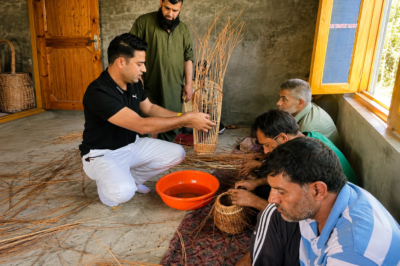
PEERPORA, GANDERBAL, J&K: For generations, willow wicker has been woven into the cultural and economic fabric of Kashmir. In the villages of Ganderbal, the traditional craft known locally as Keani Keam has survived through the skilled hands of artisans who transform Salix purpurea, or purple willow, into baskets, household articles and agricultural products.
But in an age of changing consumer preferences and increasingly competitive markets, tradition alone could not guarantee survival.
For years, artisans faced a familiar cycle of low-value products, limited market access, dependence on intermediaries, inadequate product diversification and declining interest among younger generations. Traditional basket weaving could generate as little as ₹200 for a full day’s labour, according to the documented success story of the Peerpora Willow Wicker Craft Cluster.
Today, however, a different story is beginning to emerge.
Through a combination of skill development, design innovation, improved processing, institutional organisation and market exposure, Peerpora’s willow wicker ecosystem is moving beyond subsistence production and taking its first determined steps towards becoming a modern rural enterprise.
When a Centuries-Old Craft Faced a Modern-Day Crisis
The problem was never a lack of raw material or craftsmanship.
Ganderbal’s agro-climatic conditions are favourable for willow cultivation, providing the basic material that sustains the craft. The real challenge was economic.
For decades, production remained concentrated around utilitarian products such as Kangris and traditional seasonal baskets. While culturally important, these products generated relatively limited commercial value and offered few financial incentives for younger people to enter the profession.
Artisans were also heavily dependent on intermediaries for both procurement and sales. This fragmented structure reduced their bargaining power and meant that a significant portion of the final value generated by the craft did not necessarily reach the artisan.
Raw-material preparation posed another challenge. Variations in boiling, peeling, grading and storage could lead to breakage and inconsistent product quality.
The consequences were serious.
Low prices resulted in low incomes. Low incomes discouraged younger people. And fewer young artisans meant that a body of traditional knowledge accumulated over generations was increasingly at risk of disappearing.
A 60-Day Intervention With a Long-Term Ambition
The turning point came with the Karigar Utthan Upskilling Programme, implemented under the Guru Shishya Hastashilp Prashikshan Programme (GS HPP).
At the Peerpora cluster, the initiative was conducted from July 27 to September 24, 2024, as a 60-day intensive programme under the National Handicraft Development Programme.
The Office of the Development Commissioner (Handicrafts), Ministry of Textiles, along with the Handicrafts Service Centre, Srinagar, played key institutional roles in the intervention.
The objective was straightforward but ambitious: make the craft economically viable without disconnecting it from its traditional roots.
Rather than viewing artisans simply as recipients of training, the programme sought to equip them with skills that could help them become stronger producers, designers and entrepreneurs.
At the heart of the initiative was the traditional Guru-Shishya model, through which experienced craftspeople could transfer advanced techniques and accumulated knowledge to a younger generation.
In effect, the programme sought to build a bridge between heritage and innovation.
When Willow Became a Lifestyle Material
Perhaps the most visible transformation has taken place in product design.
The training moved beyond conventional baskets and encouraged artisans to explore products aimed at contemporary homes, lifestyle markets and premium consumers.
Willow began appearing in the form of:
- Designer lampshades and ambient lighting
- Premium picnic hampers
- Laundry and storage baskets
- Circular sling bags and tote bags
- Furniture and seating products
- Decorative wall pieces
- Gift collections and lifestyle accessories
Among the distinctive creations is a mushroom-shaped willow ambient light, where traditional weaving techniques meet contemporary interior aesthetics.
The addition of leather straps, metal hardware and mixed-media construction has further expanded the design possibilities of willow.
This is more than a simple change in the product catalogue.
It represents a change in the economic perception of the craft.
A conventional basket primarily competes on price and utility. A thoughtfully designed lifestyle product can compete on craftsmanship, aesthetics, sustainability, cultural identity and storytelling.
That is where traditional craft begins to acquire modern commercial value.
From ₹200 a Day to Premium Products Worth ₹1,200
Perhaps the most striking indication of change is found in the documented income figures.
Before the intervention, traditional basket weaving could generate approximately ₹200 for a full day’s labour.
Following the intervention, a premium circular willow sling bag was reported to command around ₹1,200, involving approximately six hours of skilled work.
The documented comparison further places average monthly artisan income at approximately ₹8,000–₹14,000 by March 2026, compared with roughly ₹1,500–₹2,500 before the programme.
These figures underline an important lesson in craft development:
Artisan income does not always have to rise through producing more. It can rise by creating more value from the same skill.
Design, quality, branding and direct access to markets can transform the economics of traditional craftsmanship.
Breaking the Middleman Chain
Another important development has been the movement towards collective organisation.
The formation of the Sherpathri Willow Wicker Craft Producer Company under the Ambedkar Hastashilp Vikas Yojana has created a collective platform for artisans from key production centres including Kachan, Peerpora, Shallabugh and Haran.
The producer-company model addresses one of the longstanding weaknesses of traditional craft economies: fragmentation.
An individual artisan working alone may struggle to negotiate with large buyers, access finance, procure raw materials at favourable rates or reach distant markets.
A collective structure can change that equation.
It can provide artisans with greater scope for collective bargaining, formal financial access, profit-sharing, quality improvement, product development and market engagement.
In simple terms, the transformation is from isolated craft workers to organised rural entrepreneurs.
The G20 Moment: Kashmir Willow Takes the Global Stage
The craft’s growing ambition received an important boost when premium willow products were showcased during the G20 Tourism Working Group meeting at the Sher-i-Kashmir International Convention Centre (SKICC), Srinagar.
For the artisans of Ganderbal, the significance extended far beyond an exhibition.
Willow lampshades, circular sling bags and luxury picnic hampers were presented before an international audience, giving the products exposure to potential buyers and demonstrating that a traditional Kashmiri craft could speak the language of contemporary global markets.
The showcase also helped reshape the image of willow wicker.
It was no longer simply a rural household craft.
It could be presented as sustainable lifestyle merchandise with applications in home décor, fashion, gifting and contemporary interiors.
That change in perception can be as important as the change in product itself.
From International Exposure to National Recognition
The transformation subsequently received national recognition through the National ODOP Award for Willow Wicker for Ganderbal district.
The recognition is significant within the broader One District One Product approach, which seeks to build economic ecosystems around distinctive local products.
For Ganderbal, willow wicker offers a natural foundation for such an ecosystem.
It brings together local raw material, inherited craftsmanship, community participation and the potential for modern design and commercial expansion.
The story demonstrates that cultural preservation and economic development do not necessarily have to exist in separate worlds.
With the right ecosystem, heritage can become an economic asset rather than an economic burden.
Digital Payments, E-Commerce and a New Generation
The transformation is also extending beyond workshops and exhibitions.
Artisans are exploring direct-to-consumer channels, craft fairs, government procurement opportunities and digital commerce. The documentation notes efforts towards onboarding artisans on Indiahandmade.com and other premium handicraft platforms.
The adoption of UPI-based digital payments at artisan stalls is another important step, bringing traditional craft transactions into the formal digital economy and reducing dependence on cash-based trade.
But perhaps the most important development is the growing possibility of attracting young people back towards the craft.
For any heritage tradition, survival ultimately depends on whether the next generation sees it as a viable future.
When craftsmanship is connected with design, entrepreneurship, technology and modern markets, traditional work can acquire a new meaning.
For young people, heritage no longer has to mean simply preserving the past.
It can mean building a livelihood from it.
A Rural Economy Built Around Willow
The impact potentially extends far beyond individual artisans.
The documented transformation estimates that more than 4,000 families are indirectly connected to the willow wicker value chain, including raw-material growers, artisans, finishing workers, packaging personnel and logistics providers.
The programme also places emphasis on women artisans, skill development and cooperative participation.
This creates the possibility of a much wider rural economic ecosystem—one stretching from willow cultivation and processing to weaving, finishing, design, packaging, marketing and distribution.
Such an ecosystem can have consequences beyond handicrafts.
It can strengthen household incomes, generate local employment and create additional economic opportunities within rural communities.
In the long term, a thriving local craft economy could also help reduce the economic pressures that often contribute to rural migration.
The Road Ahead: From Revival to a Global Brand
The revival of Peerpora’s willow wicker is an encouraging development, but it is not the final destination.
The next challenge is to ensure that the momentum becomes sustainable.
The documented success story identifies several priorities, including:
Geographical Indication (GI) registration, strengthening the producer-company structure, expanding e-commerce and digital market access, establishing a dedicated design and innovation centre, developing export linkages and continuing advanced skill training.
Each of these steps could play a critical role.
A GI identity could strengthen the regional character and premium positioning of Ganderbal’s willow wicker.
A permanent design and innovation centre could ensure that product development continues beyond individual training programmes.
Stronger digital and export linkages could connect local artisans with consumers seeking sustainable home décor, fashion accessories and environmentally conscious lifestyle products.
And continuous training would allow the craft to evolve while retaining its traditional identity.
The Bigger Lesson From Peerpora
The story unfolding in Peerpora carries a lesson far beyond willow wicker.
Traditional crafts do not always disappear because people stop respecting culture.
They often disappear because the economic system supporting that culture becomes unsustainable.
That is why genuine revival requires more than nostalgia.
It requires skills.
It requires design.
It requires finance.
It requires organisation.
It requires technology.
And, above all, it requires access to markets.
The Peerpora experience attempts to bring these elements together.
A 60-day intervention cannot by itself guarantee the survival of a centuries-old craft. But it can demonstrate what becomes possible when traditional knowledge is connected with modern markets and sustained institutional support.
The transformation from a low-value ₹200-a-day activity to premium products capable of generating substantially higher returns is therefore not simply a story about baskets, bags or lampshades.
It is a story about recognising value where it already exists.
The hands that preserve cultural heritage can also become the hands that build rural businesses.
The Human Story Behind the Transformation
At the centre of this journey is the artisan—the person whose skill gives life to every willow strand.
The success story has been documented by Shri Mohammad Rafiq Sheikh, AD (A&C), HSC, Office of the Development Commissioner (Handicrafts), Ministry of Textiles, Srinagar, Jammu & Kashmir.
The Handicrafts Service Centre, Office of the Development Commissioner (Handicrafts), Srinagar, has provided continuous handholding support, guidance and encouragement to the artisan throughout the journey.
That institutional relationship is an important part of the story.
Skill training may open a door, but sustained guidance can help an artisan walk through it.
With continued support and determination, the artisan has successfully demonstrated that handicrafts can serve as a viable means of livelihood—not merely as a supplementary traditional occupation.
The journey also carries a message for thousands of other artisans.
Traditional skills can become economically meaningful when they are connected to contemporary design, better markets, organised production and institutional support.
A Message to the Next Generation
Perhaps the most powerful outcome of the Peerpora experience is the possibility of changing how young people perceive traditional craftsmanship.
For years, many young people have associated artisanal occupations with low income, limited opportunities and an uncertain future.
The emerging willow wicker model offers another possibility.
What if traditional craftsmanship could become a design profession?
What if a village workshop could serve global consumers?
What if a young artisan could use digital payments, e-commerce, contemporary design and social media while working with a material his or her ancestors used generations ago?
That is the future that Peerpora is beginning to explore.
And if that future takes root, it could help preserve not only a craft but also the dignity, knowledge and economic identity of an entire artisan community.
From Heritage to Enterprise
Ganderbal’s willow wicker story is ultimately about much more than the revival of a traditional craft.
It is about the transformation of heritage into opportunity.
The humble willow rod is being given a new language—one that speaks simultaneously to Kashmir’s cultural identity, India’s rural economy and a global consumer increasingly interested in sustainable products.
The challenge now is to sustain that momentum.
If institutional support continues, if artisans remain organised, if design innovation becomes a permanent process and if domestic and international markets continue to open, Ganderbal’s willow wicker could evolve from a traditional craft into a recognisable premium brand.
The craft has already survived generations.
Now it faces a different test—not whether it can survive the past, but whether it can conquer the future.
And in Peerpora, that future is being woven—one willow strand at a time.





Leave a Reply