
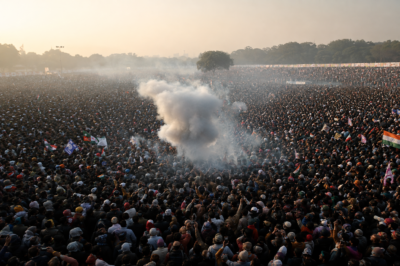
NEW DELHI: The national capital has once again become the centre of a high-stakes political confrontation, with Congress leader Rahul Gandhi leading a dharna over the alleged injury of a young citizen, Sahil. The protest has brought questions of police accountability, civil liberties and the democratic right to peaceful dissent sharply into the public spotlight.
At the heart of the controversy is Sahil’s allegation that he sustained injuries from a pellet gun during a recent confrontation. According to the account presented by the Congress, the New Delhi Deputy Commissioner of Police has acknowledged receipt of his complaint. The circumstances surrounding the alleged injury, however, remain subject to investigation.
The Congress has turned the case into a wider demand for accountability, arguing that allegations of excessive force against citizens cannot be ignored. Rahul Gandhi’s decision to take the issue to the streets signals an attempt to move the political battle beyond Parliament and directly before the public.
The controversy also raises broader questions about the use of force during demonstrations. Any allegation involving pellet guns inevitably brings renewed attention to issues of proportionality, police procedures and the protection of citizens during public gatherings. The outcome of the complaint and any subsequent inquiry will therefore be closely watched.
Politically, the dharna represents another chapter in Rahul Gandhi’s emphasis on grassroots mobilisation and public engagement. For the Congress, the protest provides an opportunity to project itself as a voice for civil liberties and government accountability. For its critics, however, the demonstration may be viewed through the lens of political strategy and opposition mobilisation.
In the age of social media, images and videos from the protest are likely to shape public perceptions as quickly as official investigations develop. That makes responsible reporting and verification particularly important.
Ultimately, the Sahil case has moved beyond a single confrontation. It has become a test of how democratic India balances public order with accountability, state authority with individual rights, and political protest with the rule of law. The investigation will determine the facts; the larger debate over dissent and policing is already unfolding on the streets of New Delhi.





Leave a Reply