
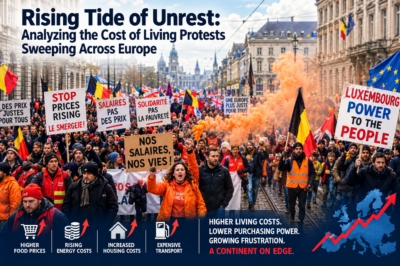
Europe is experiencing a period of growing economic and social uncertainty as rising living expenses, persistent inflation and stagnant wages place increasing pressure on millions of households. Protests across Belgium, France, Italy and Portugal reflect widespread public dissatisfaction with the deteriorating affordability of essential goods and services. The unrest highlights the challenges faced by European governments in protecting citizens from economic shocks while maintaining financial stability.
The continuing effects of the COVID-19 pandemic, disruptions to international supply chains and geopolitical tensions surrounding the Russia–Ukraine conflict have contributed to higher energy and commodity prices. Europe’s efforts to diversify its energy supplies following reduced dependence on Russian resources have involved substantial economic adjustments. Higher electricity and fuel costs have affected households, businesses and industrial production, while rising food prices have further weakened consumers’ purchasing power. For families with limited incomes, meeting basic needs has become increasingly difficult.
In Belgium, trade unions have intensified their demands for improved wages, effective inflation protection and affordable energy. Workers argue that existing wage adjustment mechanisms do not adequately address the actual increase in living expenses. In France, demonstrations reflect a combination of economic grievances, dissatisfaction with pension reforms and concerns over the protection of workers’ rights. Industrial action in key sectors has also brought renewed attention to the distribution of corporate profits and the financial difficulties experienced by ordinary employees.
Southern European countries face additional structural challenges. In Italy, demands for stronger employment protections, a national minimum wage and greater assistance for vulnerable households have gained importance amid concerns over youth unemployment and economic stagnation. Meanwhile, Portugal is confronting an increasingly difficult housing situation, particularly in major cities where rising property prices and rental costs have outpaced the earnings of many local residents. These pressures have intensified concerns among younger generations about employment opportunities, financial independence and future security.
The growing unrest has also raised questions about Europe’s energy policies, economic competitiveness and the fairness of the transition towards renewable energy. Citizens are calling for stronger consumer protection, greater accountability for excessive profits and measures to ensure that environmental reforms do not disproportionately burden low-income households.
Financial markets are closely monitoring the consequences of prolonged industrial disputes, political uncertainty and additional public spending. Disruptions to production, declining consumer confidence and concerns about government debt could further complicate Europe’s economic recovery. At the same time, the renewed prominence of labour unions and public demonstrations reflects increasing demands for more inclusive economic policies.
Addressing the crisis requires a comprehensive strategy combining targeted financial assistance, fair wage growth, affordable housing, energy security and sustainable employment. Governments must also strengthen social protection while maintaining responsible fiscal management.
Ultimately, the protests represent a broader demand for economic fairness, dignity and security. Europe’s long-term stability will depend on its ability to reconcile economic growth with social justice and ensure that the benefits of development are shared more equitably across society.






Leave a Reply