
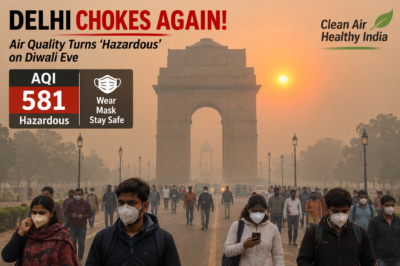
Toxic air, rising health risks and economic losses renew the debate over pollution control, regional cooperation and the need for lasting environmental solutions.
The recurring pollution crisis in Delhi during the Diwali season is a stark reminder of the environmental challenges confronting India’s capital. With air quality deteriorating sharply and several monitoring stations reportedly recording AQI levels above 400, residents face renewed concerns over respiratory illnesses, public health and the quality of urban life.
According to IQAir’s live global ranking on November 7, Delhi topped the list of the world’s most polluted major cities, recording a US AQI reading of 581. India’s Central Pollution Control Board (CPCB), using its own methodology, recorded Delhi’s AQI at 363, in the ‘very poor’ category. Several monitoring stations reported readings above 400, with IIT Delhi recording particularly high pollution levels.
The crisis is driven by a combination of vehicular emissions, construction dust, industrial pollution, crop-residue burning in neighbouring states and unfavourable winter weather conditions that trap pollutants close to the ground. The Commission for Air Quality Management (CAQM) has invoked Stage III of the Graded Response Action Plan (GRAP) across the NCR, introducing additional restrictions to limit pollution.
The consequences extend far beyond environmental statistics. Prolonged exposure to polluted air increases health risks, particularly for children, elderly people and those suffering from respiratory or cardiovascular conditions. Outdoor workers and economically vulnerable families are especially exposed, highlighting the growing inequality in access to clean air.
Delhi’s pollution problem cannot be solved through temporary restrictions imposed every winter. It requires coordinated action by the governments of Delhi, Punjab, Haryana, Uttar Pradesh and the Centre, alongside cleaner transport, effective industrial monitoring, scientific crop-residue management and strict dust control.
The Festival of Lights should illuminate homes and bring happiness to families, not expose millions to hazardous air. Delhi needs more than emergency measures; it needs a sustained commitment to make clean air a fundamental reality of urban life.





Leave a Reply