
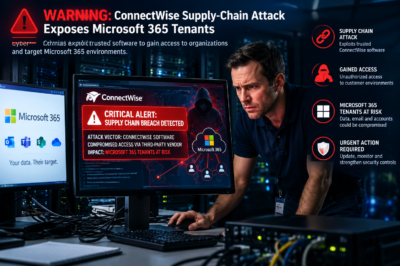
The global cybersecurity environment faces increasingly complex challenges as organisations become more dependent on interconnected digital services. Reports of a potential supply-chain security incident involving ConnectWise, a major provider of software used by Managed Service Providers (MSPs), highlight the risks associated with placing extensive trust in third-party technology platforms. Such incidents can expose numerous businesses to security threats, particularly when remote management tools are connected to Microsoft 365 environments.
MSPs play a vital role in supporting small and medium-sized enterprises by managing IT infrastructure, maintaining systems and providing technical assistance. However, the privileged access required to perform these functions can become a serious security weakness if the management platform or its administrative credentials are compromised. A successful attack could potentially expose business communications, confidential documents and critical operational systems. The specific scope and impact of any reported ConnectWise incident should be established through verified security advisories and official disclosures.
Understanding the Supply-Chain Security Risk
Remote Monitoring and Management (RMM) tools enable service providers to administer client systems, install updates and resolve technical problems remotely. Although these capabilities improve efficiency, they also create a potentially valuable entry point for cybercriminals. If attackers compromise a management platform, its integrations or privileged accounts, they may gain access to multiple customer environments through a single point of failure.
The danger is particularly significant where third-party service providers possess delegated administrative permissions within Microsoft 365 or Microsoft Entra ID. Depending on the permissions obtained, attackers could modify user accounts, access sensitive information, manipulate email settings or disrupt business operations. These possibilities demonstrate why organisations must carefully control privileged access and regularly assess the security of their technology suppliers.
Why Microsoft 365 Is a Valuable Target
Microsoft 365 supports essential business activities, including email communication, document management, online meetings and collaborative working. Its services, such as Outlook, Teams, OneDrive and SharePoint, may contain commercially sensitive information, financial records and confidential corporate discussions.
Unauthorised access to these systems can facilitate business email compromise, invoice fraud, identity theft, data theft and ransomware deployment. Cybercriminals may impersonate executives or suppliers, redirect payments and exploit trusted communication channels to deceive employees. Consequently, protecting cloud accounts requires more than securing individual devices; it also demands strong identity management, effective monitoring and careful oversight of third-party access.
Social Engineering and Professional Networks
Professional networking platforms such as LinkedIn can be misused for reconnaissance and social engineering. Attackers may create fraudulent profiles, impersonate technical support personnel or distribute deceptive messages containing malicious links and attachments. Publicly available employee information and business relationships can also help criminals identify potential targets.
Organisations should therefore verify unexpected security notifications through official channels, scrutinise suspicious links and provide regular cybersecurity awareness training. Professional familiarity should never be treated as proof that a message or request is genuine.
Financial Consequences and Business Continuity
A serious supply-chain incident can generate substantial expenses through forensic investigations, system restoration, legal assistance, regulatory compliance and business interruption. Affected service providers may also face reputational damage, contractual disputes and increased insurance costs. For smaller businesses, prolonged disruption or the loss of sensitive information may threaten their long-term viability.
Such incidents underline the importance of evaluating third-party cyber risks as part of organisational governance. Businesses must assess not only the security of their own systems but also the safeguards maintained by vendors and service providers with access to their infrastructure.
Essential Security Measures
Organisations and MSPs should adopt a proactive, layered approach to cybersecurity:
- Review administrative access: Audit delegated permissions and remove unnecessary privileges from Microsoft 365 environments.
- Implement Zero Trust: Grant access according to verified identity, device security and business requirements rather than assumed trust.
- Strengthen authentication: Use phishing-resistant multifactor authentication, preferably hardware security keys where appropriate.
- Improve monitoring: Enable audit logging, investigate unusual administrative activity and monitor suspicious changes to email and identity settings.
- Isolate management systems: Restrict RMM tools through network segmentation and tightly controlled access policies.
- Prepare recovery plans: Maintain secure backups, incident-response procedures and tested business-continuity arrangements.
- Verify vendor communications: Obtain security updates and incident guidance directly from authenticated, official sources.
Conclusion: Building a More Resilient Digital Future
Supply-chain cybersecurity threats demonstrate that the security of an organisation depends partly on the reliability of its technology partners. As cloud services and remote administration become increasingly interconnected, a single compromised platform can potentially create consequences across multiple businesses.
The way forward requires stronger vendor accountability, transparent incident reporting, continuous security assessments and close cooperation among software developers, MSPs and customers. By embracing Zero Trust principles, limiting privileged access and investing in rapid detection and recovery, organisations can reduce the likelihood and impact of future attacks.
Ultimately, cybersecurity must be treated as an ongoing organisational responsibility rather than a one-time technical exercise. Protecting digital trust is essential not only for safeguarding information but also for maintaining business continuity, financial stability and confidence in the global digital economy.






Leave a Reply