
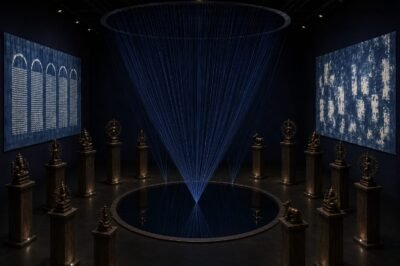
A unique exhibition at the National Crafts Museum & Hastkala Academy brings India’s ancient craft vocabulary into dialogue with contemporary artistic expression
India’s crafts are far more than objects of beauty. They are repositories of memory, identity and collective imagination—each woven thread, carved surface, painted motif and handcrafted form carrying traces of the community, region and cultural traditions from which it emerged.
It is with this profound understanding of India’s living craft heritage that the National Crafts Museum & Hastkala Academy (NCM&HKA), Pragati Maidan, New Delhi, has emerged as one of the country’s most important institutions dedicated to preserving and presenting India’s extraordinary handcrafted legacy.
Established under the Ministry of Textiles, Government of India, the museum houses an exceptional collection of traditional handcrafted objects gathered from different parts of the country. Many of these masterpieces are associated with celebrated artisans and Mastercraftspersons and represent skills that have been refined and transmitted across generations.
Every object in the collection tells a story.
A textile may reveal the visual language of a particular community; an embroidered panel may preserve a centuries-old tradition; a sculptural object may embody a region’s spiritual imagination; while a weaving technique can speak silently about the social and economic life of the people who practised it.
In this sense, the museum is not merely a place where historic objects are displayed. It is a living classroom of Indian civilisation.
A Museum That Connects Generations
The significance of NCM&HKA extends beyond preservation. Its collections have become an important source of study for students, researchers, designers, scholars and institutions from India and abroad.
Research groups and students visiting the museum get an opportunity to examine traditional techniques, materials, motifs, construction methods and aesthetic principles at close quarters. The preserved objects consequently become powerful learning tools for a younger generation seeking to understand India’s craft traditions and their relevance in the contemporary world.
The museum’s exhibitions further strengthen this educational mission by placing objects within fresh conceptual frameworks and encouraging visitors to look at familiar traditions through new perspectives.
It is against this backdrop that the forthcoming exhibition “Adiyogi Shiva in Vastu Shilpa: Tradition and Modernity” assumes special significance.
Adiyogi Shiva: From Eternal Symbol to Contemporary Expression
Conceived under the leadership of Ms. Nidhi, Curator & Deputy Director (Design & Documentation), NCM&HKA, the proposed exhibition seeks to create a compelling dialogue between India’s age-old artistic traditions and contemporary creativity.
At its heart is the timeless imagery of Adiyogi Shiva, interpreted through the museum’s treasured collection of traditional crafts and juxtaposed with contemporary indigo-dyed artworks on Khadi designed by textile exponent Ms. Sangeeta Gupta.
The exhibition will bring these two creative expressions together—not to suggest that tradition and modernity are opposites, but to demonstrate that tradition can continuously evolve while retaining its cultural soul.
The exhibition is envisioned in two interconnected sections.
The Traditional Imagination of Adiyogi
The first section will explore traditional representations of Adiyogi Shiva through a rich selection of decorated textiles and three-dimensional craft traditions.
Works such as Sajni Kantha, Kalamkari, Pichwai, Ajrakh and Appliqué will form part of this visual journey, complemented by bronze and other sculptural exhibits drawn from the museum’s reference collection.
Together, these works reveal how the image and symbolism of Shiva have travelled across regions, communities and artistic traditions.
The exhibits demonstrate remarkable variations in form, technique, colour, composition, material and symbolic vocabulary. Yet beneath these differences lies a shared cultural imagination—the enduring presence of Shiva as a powerful symbol of creation, transformation, transcendence and cosmic consciousness.
The section therefore becomes more than an arrangement of historic objects. It becomes a journey through the evolution of India’s artistic imagination.
When Khadi Meets Indigo
The second section moves from historical craft traditions into contemporary artistic expression.
Here, the graphic and symbolic vocabulary of Shiva is reinterpreted through large-scale textile artworks created on hand-spun Khadi fabric using indigo resist-dyeing techniques by Ms. Sangeeta Gupta.
The deep visual character of natural indigo, combined with the tactile quality of Khadi, creates a striking contemporary medium through which the eternal form of Adiyogi is revisited.
These works do not simply reproduce traditional imagery. Instead, they seek to reconfigure the visual language of Shiva, creating a dialogue between ancient symbolism and modern artistic sensibilities.
The result is a fascinating transition—from museum objects representing inherited traditions to contemporary textile art inspired by those very traditions.
Vastu Shilpa: A Continuum, Not a Relic
The deeper message of the exhibition lies in its understanding of Vastu Shilpa not as a static heritage frozen in time, but as an evolving continuum.
Indian artistic traditions have historically absorbed new materials, techniques, ideas and influences while retaining their essential cultural character. The proposed exhibition seeks to make this process visible.
A traditional embroidered textile and a contemporary indigo artwork may appear separated by time, technique and artistic vocabulary. Yet both can communicate the same cultural memory through different creative languages.
This is where the exhibition acquires its contemporary relevance.
It demonstrates that preservation does not necessarily mean freezing tradition in its original form. True preservation can also mean allowing traditional knowledge to inspire experimentation, innovation and new forms of expression.
Shiva as a Symbol Beyond the Divine
Within the Indian cultural imagination, Shiva is not merely a divine figure. Adiyogi represents a profound symbolism of cosmic energy, transformation, transcendence and eternal bliss.
This multilayered symbolism provides an exceptionally rich foundation for artistic interpretation.
Through textiles, natural dyes, embroidery, painting, sculpture and other handcrafted mediums, different generations of craftspeople have explored this eternal symbolism according to their own regional aesthetics and creative vocabulary.
The exhibition brings these diverse interpretations together to demonstrate the extraordinary ability of Indian crafts to preserve cultural memory while simultaneously responding to changing artistic contexts.
A Bridge Between Past and Future
One of the most compelling features of “Adiyogi Shiva in Vastu Shilpa: Tradition and Modernity” is the deliberate meeting of two worlds.
On one side stand the carefully preserved masterpieces of India’s traditional craft heritage. On the other are contemporary creations that reinterpret an eternal cultural symbol through Khadi and natural indigo.
Between them lies a creative bridge.
That bridge represents the continuing journey of Indian craftsmanship—from ancestral knowledge to contemporary experimentation, from community traditions to modern artistic practice, and from preservation to innovation.
For young visitors and students, the exhibition can provide an especially valuable lesson: heritage is not something that belongs only to the past. It can become a foundation upon which new ideas are built.
Craft as Cultural Memory
The proposed exhibition also underlines a larger responsibility shared by museums, artisans, designers, researchers and cultural institutions—to ensure that India’s extraordinary craft knowledge remains accessible to future generations.
Every preserved object represents more than material value. It represents human skill, community knowledge, cultural memory and countless generations of creative endeavour.
By bringing these objects into conversation with contemporary artistic practices, the exhibition creates an opportunity to understand how India’s craft traditions remain relevant in the present.
Celebrating the Living Spirit of Indian Craft
“Adiyogi Shiva in Vastu Shilpa: Tradition and Modernity” promises to be more than an exhibition of beautiful objects. It is an intellectual and visual exploration of how tradition survives by transforming itself.
Through the curatorial vision of Ms. Nidhi, Curator & Deputy Director (Design & Documentation), the exhibition seeks to demonstrate that India’s artistic heritage is neither static nor confined to museum vitrines. It continues to breathe through artisans, designers, textiles, materials, techniques and contemporary creative practices.
Ultimately, the exhibition celebrates a simple but powerful idea:
Tradition provides the roots; creativity gives it new branches.
And in the timeless image of Adiyogi Shiva, the exhibition discovers a remarkable metaphor for that journey—eternal in essence, yet continually renewed through the imagination of each generation.
The exhibition is likely to commence on Tuesday and continue until 21st September 2026, offering the public an opportunity to experience this unique confluence of India’s traditional craft heritage and contemporary artistic expression.
Visitors are encouraged to support the exhibition by spending a little time in the gallery and engaging with the artworks. Even a small gesture of public presence and appreciation can provide immense encouragement to the artist and crafts community. For every artist, recognition, appreciation and meaningful interaction with viewers are invaluable sources of motivation.
The exhibition therefore invites craft lovers, students, researchers, art enthusiasts and the general public to come forward, witness the creative journey of Adiyogi Shiva from tradition to modernity, and extend their appreciation to the artists whose dedication keeps India’s rich cultural heritage alive.






Leave a Reply