
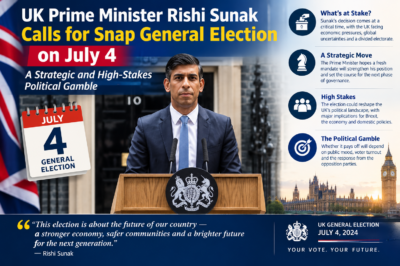
British Prime Minister Rishi Sunak’s announcement of a snap general election for 4 July 2024 took many political observers by surprise. By calling the election earlier than widely anticipated, Sunak sought to capitalise on emerging signs of economic improvement and present voters with a choice between the Conservatives’ approach to governance and the alternative offered by the Labour Party. With the Conservatives trailing in opinion polls, the decision represented a significant political gamble.
One of the principal factors behind the election timing was the recent decline in inflation to 2.3%, alongside stronger-than-expected economic growth of 0.6% in the first quarter of 2024. Sunak and Chancellor Jeremy Hunt intended to use these indicators to argue that the economy was recovering and that the government’s policies were beginning to deliver results. The Conservatives also highlighted National Insurance reductions and the possibility of further tax cuts. However, households continued to face a high cost of living, while the overall tax burden remained a major concern.
The Labour Party, led by Sir Keir Starmer, responded with a message of “Change,” portraying the preceding 14 years of Conservative rule as a period marked by political instability, weak growth and pressure on public services. Labour emphasised economic stability, NHS improvements, clean energy through its proposed Great British Energy initiative and stronger border security through a new Border Security Command. Its challenge was to demonstrate fiscal responsibility while convincing voters that a change of government could improve national conditions.
The election also carried implications for financial markets. Investors closely monitored the parties’ positions on taxation, corporate investment, environmental policies and the United Kingdom’s future trading relationship with the European Union. A clear electoral mandate was generally considered preferable to a hung parliament, which could create uncertainty over policymaking.
Electoral competition was further complicated by Reform UK, which threatened to divide Conservative support, and the Liberal Democrats, who targeted Conservative-held constituencies, particularly in southern England. These dynamics made the contest highly competitive across different regions.
Ultimately, the 4 July election represented a decisive moment for Britain’s political and economic direction. The next government would face persistent challenges, including weak productivity, pressure on public services, ageing infrastructure and global geopolitical uncertainty. The outcome would therefore shape not only the leadership of the country but also its economic priorities, public policies and international position in the years ahead.






Leave a Reply