
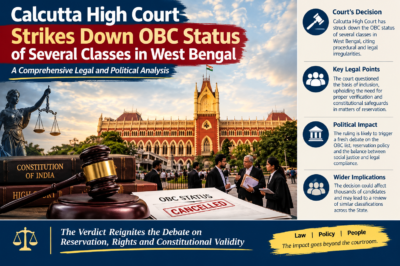
The Calcutta High Court’s landmark judgment striking down the Other Backward Classes (OBC) status of 77 classes in West Bengal has reignited the national debate on reservation, social justice and the constitutional limits of executive authority. The decision primarily concerns classifications made under the West Bengal Backward Classes (Other than Scheduled Castes and Scheduled Tribes) (Reservation of Vacancies in Services and Posts) Act, 2012, and the validity of OBC certificates issued to the affected communities after 2010.
At the centre of the judgment was the process followed by the state government in identifying socially and educationally backward communities. The court questioned whether the classifications were supported by adequate empirical evidence and whether the prescribed consultation and assessment procedures had been followed. It emphasised that the identification of backward classes must rest on objective criteria, credible socio-economic data and established constitutional principles rather than arbitrary administrative decisions.
The court also raised concerns about the functioning of the West Bengal Backward Classes Commission, observing that its role in examining and recommending the inclusion of communities had not been adequately discharged. The judgment underlined the importance of institutional independence, transparency and accountability in implementing affirmative-action policies.
The verdict has significant political implications. The ruling Trinamool Congress government criticised the decision, while opposition parties welcomed it as an affirmation of constitutional safeguards. The controversy has intensified discussions about the relationship between electoral considerations and the implementation of reservation policies.
The judgment has also created uncertainty for students, job seekers and other beneficiaries from the affected communities. According to the source material, individuals who had already secured government employment or educational benefits would not lose those benefits solely because of the ruling. However, future recruitment and admissions involving the affected OBC classifications could face significant changes, requiring administrative adjustments and clarification of eligibility.
Constitutional provisions under Articles 15 and 16 permit special measures for socially and educationally backward classes, but such measures must comply with established legal standards. The decision reinforces the principle that reservation policies should be evidence-based, legally sustainable and directed towards genuine disadvantage.
The West Bengal government indicated its intention to challenge the verdict before the Supreme Court. The forthcoming legal proceedings could clarify the respective powers of state authorities and the role of backward-class commissions in determining eligibility.
Ultimately, the case highlights the need to balance social inclusion with constitutional compliance. A transparent, scientifically grounded and accountable identification process is essential to ensure that reservation benefits reach deserving communities while preserving public confidence in India’s affirmative-action framework.







Leave a Reply