
The Mega Cluster Development Programme of the Office of the Development Commissioner (Handloom), Ministry of Textiles, Government of India, is aimed at the holistic development of identified handloom clusters through need-based interventions and comprehensive development plans. Under the initiative, the Sualkuchi Mega Handloom Cluster in Assam covers 68 villages and 5 Gaon Panchayats and is expected to benefit more than 10,000 weavers. The Government of India has sanctioned approximately ₹29 crore, with an additional contribution of about ₹3 crore from the Government of Assam, and the project is envisaged to continue up to 2029.
Traditionally recognised as the “Vastra Nagari”, Sualkuchi has a rich and distinguished heritage of handloom weaving. The project seeks to strengthen this traditional sector by improving productivity, earnings, working days and market opportunities. It aims to enhance the average daily earning of weavers from approximately ₹450 to ₹900, increase annual working days from around 225 to 305, and raise the cluster’s turnover from about ₹60 crore to ₹90 crore.
The project provides comprehensive support for design development and product diversification, including professional design inputs and design studios, enabling weavers to develop products in accordance with contemporary market trends and consumer preferences. Market development and export promotion interventions will facilitate participation in exhibitions, BSM/RBSM, e-commerce initiatives, exposure visits and international marketing activities, thereby strengthening market linkages and creating wider opportunities for Sualkuchi handloom products.
Significant interventions have also been envisaged for basic and technical infrastructure, including pre-loom, on-loom and post-loom facilities, dyeing and processing units, testing laboratories, common worksheds, showrooms, warehouses and other common facilities. Publicity and value-addition activities, including garmenting, apparel and environmentally friendly processing units, are expected to enhance product value, quality and marketability.
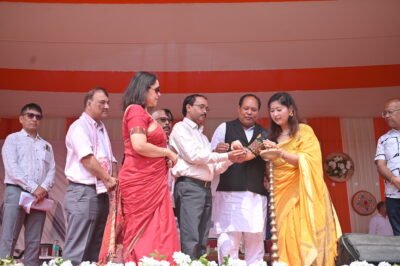
An important component of the implementation is the distribution of Tat Haal (loom machines) to targeted weavers to strengthen production capacity. As part of the formal commencement of project activities, the Hon’ble Textile Minister, Government of Assam, Shri Biswajit Daimary, participated in a ceremony for the distribution of weaving/loom machines among enlisted weavers of the Sualkuchi Cluster. On the occasion, he expressed confidence that the intervention would enable weavers to produce quality products and expand their business activities. The initiative targets approximately 4,266 weavers for coverage during implementation, with a number of looms distributed to needy participating weavers at the inaugural programme.
The ceremony was attended by senior officials and representatives, including Ms. Moyuri Ojha, Director, Directorate of Handloom and Textile, Government of Assam; Mr. Vishesh Nautiyal, Director (NER), Weavers Service Centre, Ministry of Textiles, Government of India; Shri N. N. Rana, former Additional Director, Directorate of Handloom and Textile, Government of Assam and former Managing Director, M/s ARTFED, Guwahati; and MLA Shri Prakash Ch. Das. The enthusiastic participation of thousands of weavers reflected their strong interest and eagerness to contribute to and benefit from the project.
Continued handholding by the Directorate of Handloom and Textile, Government of Assam, along with support from Apex Societies, institutional buyers, corporate houses and M/s ARTFED, Guwahati, is expected to further strengthen the cluster’s domestic and international market presence.
The Sualkuchi Mega Handloom Cluster represents an important opportunity to combine the region’s rich traditional weaving skills with modern design, technology, infrastructure and market-oriented interventions. The initiative is expected to improve productivity, income and employment while creating sustainable livelihood and business opportunities for thousands of weavers. As the textile hub of Assam, Sualkuchi has the potential to demonstrate how traditional handloom skills can become a strong foundation for enterprise development, economic self-reliance and sustainable livelihoods, while contributing to the reduction of unemployment and strengthening the handloom economy of the region.







Leave a Reply