
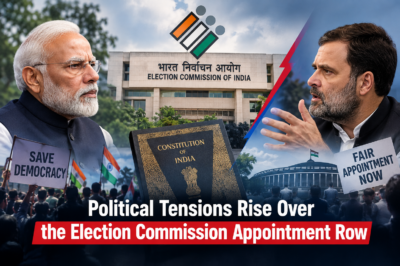
New Delhi has once again become the centre of intense political confrontation following the detention and removal of Congress leader Rahul Gandhi from an opposition protest concerning the proposed changes to the appointment mechanism for the Chief Election Commissioner (CEC) and other Election Commissioners. The episode has added another layer of tension to an already heated political environment, highlighting the widening divide between the government and opposition over the independence of democratic institutions.
The controversy revolves around the composition of the committee responsible for selecting the country’s top election officials. The opposition has strongly objected to the proposed arrangement, arguing that replacing the Chief Justice of India with a Union minister could increase the executive’s influence over appointments to the Election Commission. According to critics, such a structure could weaken the perception of institutional neutrality and raise questions about the independence of the body responsible for conducting elections.
The government, however, presents a different interpretation. It maintains that Parliament has the constitutional authority to establish an appropriate statutory framework for appointments and that legislative intervention is necessary to provide a clear and permanent mechanism. From this perspective, the proposed changes are intended to establish an orderly appointment system rather than undermine the Election Commission.
The dispute has consequently moved beyond Parliament and the courtroom into the streets of the national capital. The detention of Rahul Gandhi during the protest has become a powerful political symbol. Supporters of the Congress have described the action as an attempt to restrict democratic dissent, while authorities have defended police intervention as necessary for maintaining public order and security in a sensitive area of New Delhi.
The incident has also provided an opportunity for opposition parties to strengthen coordination. The issue of institutional independence offers the broader opposition alliance a common political platform, particularly at a time when differences among its constituent parties have frequently complicated its strategy. By taking the controversy to the public, opposition leaders are seeking to turn what might otherwise appear to be a technical legislative issue into a wider debate about constitutional values and democratic accountability.
At the heart of the controversy is public confidence in the Election Commission. Elections depend not only on rules and procedures but also on the credibility of the institutions implementing them. Any widespread perception that the electoral authority is politically influenced can affect public trust in the entire democratic process.
The confrontation therefore represents more than a disagreement over an appointment procedure. It reflects a larger debate over the balance between executive authority, parliamentary power, judicial oversight and institutional independence. The government views the proposed framework as an exercise of legislative responsibility, while the opposition sees it as a potential threat to the autonomy of a crucial constitutional institution.
Ultimately, the significance of the present political standoff will depend on how these institutional questions are resolved and how the Election Commission functions under the new framework. The episode demonstrates that democratic politics is shaped not only by elections themselves but also by the public’s confidence that the institutions conducting those elections remain fair, credible and independent.






Leave a Reply