
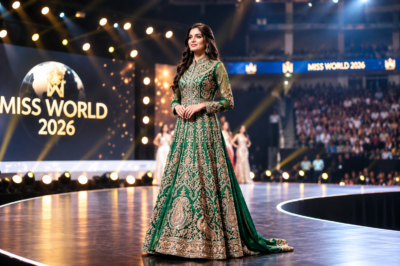
For India, international beauty pageants have always carried significance far beyond glamour and the crown. They have provided a global platform for Indian women to showcase confidence, intelligence, cultural identity and commitment to social causes. Against this backdrop, Nikita Porwal’s journey at the 72nd Miss World competition attracted enormous attention. The Femina Miss India 2024 winner entered the global contest carrying the expectations of a nation with a distinguished history in the competition. Her failure to secure a place in the Top 20 therefore came as a disappointment to many Indian supporters.
Yet, her elimination should not be viewed simply as a failure. It offers an opportunity to examine how international pageantry is changing and what India may need to do differently in future editions.
A Journey Built on Preparation
Nikita Porwal arrived at the Miss World platform after months of intensive preparation. Her background in acting and storytelling gave her an advantage in communication, presentation and stage performance. Her preparation reportedly extended beyond appearance and fashion to public speaking, current affairs, international etiquette, fitness and social advocacy.
She also sought to present an image that combined contemporary confidence with India’s cultural heritage. Her fashion choices and public appearances were designed to reflect the country’s traditions while remaining relevant to an increasingly international audience.
However, competing at the national level and competing globally are two very different challenges. At Miss World, contestants are evaluated across several dimensions, including communication, personality, fitness, social purpose and their ability to connect with audiences. A strong performance in one area cannot necessarily compensate for a weaker showing elsewhere.
The Changing Meaning of Beauty
One of the most important developments in modern pageantry is the changing definition of beauty. Miss World, in particular, has increasingly emphasized personality, purpose and social impact alongside physical presentation.
The organisation’s Beauty With a Purpose philosophy has become one of the defining elements of the competition. Contestants are expected to demonstrate meaningful engagement with social or humanitarian issues rather than simply promote themselves as beauty queens.
Nikita’s advocacy for animal welfare and environmental sustainability provided her with a socially relevant platform. However, the international competition has become increasingly crowded with contestants presenting ambitious projects involving healthcare, education, poverty reduction, women’s empowerment, environmental protection and humanitarian causes.
In such an environment, having a worthy cause may no longer be enough. The ability to demonstrate measurable results, community participation and long-term sustainability can become equally important.
An Exceptionally Competitive Field
The global pageant landscape has changed considerably. Traditional powerhouses no longer dominate international competitions as they once did. Contestants from Asia, Africa, Europe and Latin America are increasingly arriving with strong educational backgrounds, professional experience and sophisticated social campaigns.
The modern contestant may be a lawyer, doctor, entrepreneur, activist, athlete or educator before becoming a beauty queen. This broader profile has transformed the competition into a contest of personality, intellect, communication and social leadership.
For India, this means that its representatives are competing against women who are not merely accomplished in presentation but also possess substantial experience in public advocacy.
The Fast-Track Challenge
Another important aspect of Miss World is the significance of preliminary and fast-track competitions. Challenges involving public speaking, sports, audience engagement and other areas can influence a contestant’s prospects of advancing.
The scoring mechanisms are not always completely transparent to the public, making it difficult for fans to understand precisely why one contestant advances while another does not.
Consequently, a contestant can deliver an impressive overall performance yet miss the crucial combination of points required for a semi-final position. Nikita’s elimination illustrates the unforgiving nature of such a system.
The Pressure of Representing India
Representing India at Miss World comes with a unique burden. The country has produced six Miss World winners, including Reita Faria, Aishwarya Rai, Diana Hayden, Yukta Mookhey, Priyanka Chopra and Manushi Chhillar. Every new Indian contestant is therefore judged not only against her contemporaries but also against the extraordinary legacy created by these former winners.
This historical success can be both an advantage and a disadvantage. It gives an Indian contestant instant visibility and a powerful fan base, but it also creates enormous expectations.
Nikita carried that expectation with composure. Her journey demonstrated confidence, cultural awareness and the ability to handle intense international attention. Her failure to reach the Top 20 should not erase those achievements.
India’s Pageant Strategy Needs Fresh Thinking
The result nevertheless raises important questions for the Indian pageant ecosystem. Should contestants begin their social initiatives much earlier? Should projects be developed on a larger scale before the international competition? Can grooming programmes place greater emphasis on spontaneous communication, global issues and authentic storytelling?
These are questions worth examining.
The international pageant environment is evolving rapidly. A highly polished presentation remains valuable, but authenticity, emotional connection and demonstrable social impact are becoming increasingly important. Future Indian representatives may therefore need to arrive at the global stage not merely with an impressive project, but with a proven record of sustained grassroots engagement.
Social Media and the Fan Factor
Nikita’s elimination also demonstrated the enormous emotional investment of Indian audiences in international pageantry. Social media platforms became spaces for both disappointment and support, with fans questioning the result while celebrating her representation of India.
Such reactions underline the continuing popularity of beauty pageants in the country. They also demonstrate how digital audiences have transformed pageantry from a television spectacle into an interactive global event.
At the same time, fan disappointment should be separated from an objective assessment of judging. Without access to the complete scoring process, it is difficult to conclude that any particular contestant was unfairly eliminated.
A Setback, Not the End
For Nikita Porwal, the end of her Miss World campaign does not mark the end of her career. Her experience has provided international exposure and strengthened her public profile. Her background in acting, storytelling and advocacy gives her opportunities in entertainment, fashion, advertising and social initiatives.
For the Miss India Organisation, meanwhile, the result should encourage reflection rather than defensiveness. India’s impressive pageant history provides a strong foundation, but past victories cannot guarantee future success.
The next generation of Indian contestants will have to compete in a world where the meaning of a beauty queen is constantly being redefined.
Looking Beyond the Crown
Nikita Porwal’s Miss World journey ultimately represents more than a ranking. It reflects the growing complexity of international pageantry, where beauty is increasingly intertwined with intelligence, purpose, personality and social responsibility.
Her elimination may have disappointed millions of Indians, but it also provides valuable lessons. India remains a formidable force in global pageantry, yet continued success will require innovation, deeper social engagement and a willingness to adapt to changing international expectations.
A crown determines a winner, but it does not determine the value of a journey. Nikita Porwal represented India on one of the world’s most visible stages with grace and determination. Her experience can become a stepping stone—not only for her own future, but also for the Indian pageant industry as it prepares for the challenges ahead.







Leave a Reply