
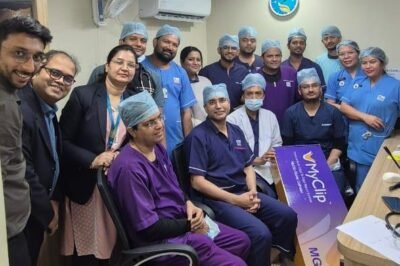
Guwahati: In a significant milestone for cardiac care, Apollo Hospital Guwahati has successfully performed the first MyClip procedure in North East India. This achievement marks a major advancement in the region’s healthcare system and highlights a breakthrough in structural heart therapy.
The procedure was led by Dr. Rituparno Baruah, Senior Interventional Cardiologist and Head of the Department of Cardiology, along with a team comprising Dr. Divya Jyoti Dutta, Dr. Chandra Kumar Das, and Dr. Chandra Prakash Thakur. The successful execution of this complex procedure reflects the hospital’s commitment to clinical excellence and its efforts to bring world-class cardiac care to patients in the North East region.
The MyClip procedure is a minimally invasive technique based on transcatheter edge-to-edge repair (TEER), used to treat severe mitral regurgitation—a condition characterized by the backward flow of blood through the mitral valve. In this high-risk case, the procedure was performed safely and effectively, and the patient was discharged in stable condition.
Notably, the device used in the procedure has been developed in India, underscoring the country’s growing capabilities in indigenous medical innovation. This achievement demonstrates how advanced healthcare technologies are reaching even the most remote regions, improving accessibility and outcomes for patients.
Speaking on the occasion, Dr. Rituparno Baruah said, “The successful use of the MyClip procedure is a moment of pride not only for our hospital but for the entire North East region and the country. Such innovations in cardiology highlight how indigenous technologies are transforming patient care and bridging critical healthcare gaps. This milestone represents the advancement of minimally invasive cardiac therapies and strengthens our journey towards self-reliance in healthcare.”
Apollo Hospitals continues to set new benchmarks in advanced cardiology. The successful implementation of the MyClip procedure is expected to pave the way for further innovations and improved cardiac care in the future.







Leave a Reply