
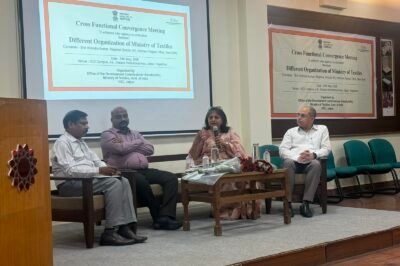
The Office of the Development Commissioner (Handicrafts), Ministry of Textiles, Government of India, organized a Cross Functional Convergence Meeting with the objective of strengthening coordination, collaboration, and convergence among various organizations/institutions for the overall development of the handicrafts sector.
The meeting was organized with the following objectives:
- To facilitate effective coordination and convergence among various departments, agencies, and stakeholders for better implementation of developmental programmes and schemes.
- To review the ongoing activities, progress, achievements, and challenges faced by different functional units/offices.
- To strengthen inter-departmental cooperation for achieving common organizational goals and ensuring timely execution of programmes/projects.
- To identify gaps, duplication of efforts, and operational issues and to evolve suitable strategies for effective resolution.
- To promote integrated planning, resource optimization, and better utilization of available infrastructure, manpower, and financial resources.
- To discuss policy matters, administrative issues, monitoring mechanisms, and field-level implementation challenges.
- To share best practices, success stories, innovations, and experiences among different regions/offices for replication and improvement.
- To improve communication, reporting systems, and decision-making processes among various functional divisions.
- To deliberate upon future action plans, targets, and collaborative initiatives for effective implementation of schemes/programmes.
- To ensure smooth functioning of official work through collective participation, accountability, and coordinated efforts among all concerned stakeholders.
The programme was held on 29th May 2026 at the campus of the Indian Institute of Craft & Design (IICD), J-8, Jhalana Institutional Area, Jaipur, Rajasthan. The meeting was chaired by Shri Virendra Kumar, Regional Director (Handicrafts), Northern Regional Office, New Delhi.
The following organizations/institutions participated in the meeting:
- Textile Committee, Jaipur
- Weaver Service Centre, Jaipur
- Indian Institute of Craft & Design (IICD), Jaipur
- Export Promotion Council for Handicrafts (EPCH), Jaipur
- Rajasthan State Handloom Development Corporation (RSHDC), Jaipur
- Poornima University, Jaipur
- Rajasthali, Jaipur
- Directorate of Industries, Jaipur
- MSME, Jaipur
- Rural Non-Farm Development Authority (RUDA), Jaipur
- Khadi and Village Industries Commission (KVIC), Jaipur
- Rajasthan Skill and Livelihoods Development Corporation (RSLDC), Jaipur
- Rajasthan Export Promotion Council (REPC), Jaipur
- Apparel Export Promotion Council (AEPC), Jaipur
- Export Credit Guarantee Corporation (ECGC), Jaipur
- National Small Industries Corporation (NSIC)
- Rajasthan Small Industries Corporation Ltd. (RAJSICO), Jaipur
- NIFT, Jodhpur
- Powerloom Service Centre, Bhilwara
- Powerloom Service Centre, Kishangarh
- GM DIC, Jaipur
Agenda Discussed
- Review of ATR on previous meeting points.
- Updates from each vertical/organization.
- Sharing of new schemes, projects, and initiatives.
- Planning of joint outreach and awareness activities.
- Discussion on field-level challenges and possible solutions.
- Planning of joint field visits/exposure visits.
- Sharing of good practices and innovations.
- Identification of issues requiring intervention at Ministry level.
Key Discussions and Decisions
• All participating organizations shared updates regarding their ongoing activities, schemes, and outreach programmes related to handicrafts, handloom, MSME, skill development, exports, and artisan welfare.
• Emphasis was laid on strengthening inter-agency coordination for better implementation of Government schemes and ensuring maximum outreach to artisans and entrepreneurs.
• It was decided that joint awareness camps and outreach activities would be organized in identified artisan clusters for creating awareness regarding Government schemes, GI registration, market linkage, exports, skilling, and financial assistance.
• Representatives highlighted several field-level challenges including market access, lack of awareness, need for skill upgradation, financial support constraints, and coordination gaps. The issues were deliberated collectively and possible solutions were discussed.
• The meeting also focused on conducting joint field visits and exposure tours for better coordination and understanding of cluster-level issues.
• Participating organizations agreed to share best practices, innovations, and success stories on a regular basis for mutual learning and effective implementation of programmes.
• It was also decided that issues requiring intervention at Ministry level would be compiled and forwarded to the concerned authorities for appropriate action.
The Convener appreciated the active participation and valuable suggestions provided by all participating organizations and institutions. The meeting concluded with a collective commitment to strengthen collaboration and work jointly for the development of the handicrafts, handloom, textile, and MSME sectors in Rajasthan.
The meeting ended with a vote of thanks to the Chair and all participants.






Leave a Reply