
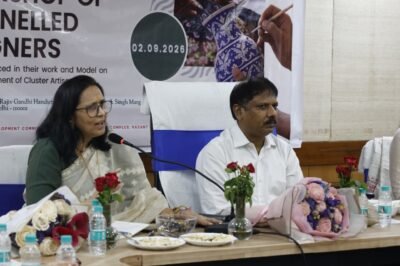
New Delhi, September 2, 2026: The Northern Regional Office of the Office of the Development Commissioner (Handicrafts), Ministry of Textiles, Government of India, organised a Seminar of Empanelled Designers at Rajiv Gandhi Handicrafts Bhawan, New Delhi, to identify field-level challenges faced by artisans and explore innovative, design-led models for enhancing the income of cluster-level artisans.
The seminar brought together empanelled designers, senior officials and invited design experts to deliberate on challenges associated with Design & Technical Development Workshops and evolve practical solutions for strengthening handicraft clusters under the Design & Technology Scheme.
Regional Director (Handicrafts) Shri Virendra Kumar welcomed the participants and dignitaries and outlined the objectives of the seminar. He underlined the important role of designers in transforming traditional skills into innovative, market-oriented products that can create better income and sustainable livelihood opportunities for artisans.
During the interaction with participating Empanelled Designers, Director (Handicrafts), Ms. Seema Mishra, ISS, shared valuable guidance on strengthening design interventions under the Design & Technology Scheme and ensuring that such initiatives result in tangible and sustainable economic benefits for artisans.
She particularly emphasised the importance of undertaking proper Design Documentation and Market Surveys as integral components of design interventions. She advised the Designers to understand emerging market trends, consumer preferences and commercial requirements so that the products developed through workshops are not only innovative but also market-oriented and commercially viable.
During the interaction, participating Designers highlighted that the existing Designer Fee was not sufficient to provide them with a sustainable source of income and requested that suitable provisions for long-term income opportunities for Designers may be considered under the Scheme.
In response, the Director (Handicrafts) advised Designers to adopt a more entrepreneurial and market-oriented approach. She encouraged them to establish strong working relationships with artisans and develop exclusive, high-quality handcrafted products during their engagement in Design Workshops. Such products should subsequently be promoted and marketed through appropriate channels to generate revenue.
She further encouraged Designers to explore opportunities for developing their own market networks, business ventures and start-ups, thereby creating sustainable professional avenues beyond the workshop-based Designer Fee.
The interaction highlighted the importance of moving from design intervention to product development, market linkage, entrepreneurship and income generation, benefiting both artisans and Designers.
Shri Virendra Kumar also made a PowerPoint presentation highlighting the seminar’s objectives and key areas of discussion. The seminar witnessed active interaction and intensive exchange of field experiences among designers. Shri Virendra Kumar divided the participating designers into five groups, each assigned specific topics to identify key issues, implementation bottlenecks and practical solutions.
Design Innovation at the Centre of Deliberations
Dr. Bindoo Ranjan, Professor, University School of Design and Innovation (USDI), Guru Gobind Singh Indraprastha University (GGSIPU), Delhi, delivered an insightful lecture on “Design-led Innovative Models for Income Enhancement of Artisans.” She highlighted the transformative potential of design innovation, product development and market-oriented strategies in enhancing the economic sustainability and competitiveness of handicraft clusters.
Dr. Ranjan urged the empanelled designers to align their individual design objectives with the broader development goals and priorities of the Ministry of Textiles, Government of India. She emphasized that design intervention in the handicrafts and handlooms sectors should not remain limited to aesthetics or product development, but should be guided by a well-defined strategic design-development plan, similar to the strategic approaches adopted in corporate and business systems.
She pointed out that the design-development strategy for handicrafts and handlooms needs to be distinctly different, keeping in view their cultural identity, traditional knowledge, artisan skills, production realities and market requirements. In this context, she introduced the “7S Principles of Social Design,” developed as part of her Ph.D. research.
The seven principles are:
- Sundar – Ensuring aesthetic appeal and visual attractiveness of products.
- Sahaj – Making products and production processes easy and practical for artisans.
- Sasta – Ensuring affordability and value for money for consumers while maintaining artisan viability.
- Samajik – Promoting collaborative and participatory working relationships with artisans.
- Sanskritik – Preserving traditional values, cultural identity and heritage while developing contemporary designs.
- Samman – Ensuring dignity, recognition and mutual respect for both artisans and designers.
- Satat – Integrating sustainability into design, production, materials and consumption practices.
Dr. Ranjan emphasized that these principles can provide a people-centric and culturally sensitive framework for design interventions, helping designers move beyond conventional product development towards sustainable livelihood enhancement, stronger market linkages and greater income opportunities for artisans.
Ms. Nidhi, Deputy Director (Design & Documentation), National Crafts Museum & Hastkala Academy, delivered an insightful session on the scope for introducing contemporary designs while preserving the traditional identity and cultural heritage of Indian handicrafts. She emphasised that design innovation should maintain a careful balance between the authenticity of traditional crafts and the evolving preferences of consumers and markets.
She particularly stressed that religious and culturally significant crafts must be designed with due respect to their traditional, spiritual and cultural values, while exploring commercially viable forms and applications. Such an approach can help expand market opportunities without compromising the sanctity and identity associated with these crafts.
Ms. Nidhi also highlighted the potential of fusion of two or more craft traditions in the development of contemporary handcrafted products. Combining different crafts, techniques, materials or decorative elements can enhance the aesthetic and functional value of products, provide artisans with greater opportunities for creativity and diversification, and ultimately help them secure better returns.
She further observed that a designer must first understand the artisan, the craft tradition and the techniques involved. According to her, a designer who develops a deep understanding of the artisan’s skills and traditional processes is better positioned to create meaningful and sustainable design interventions.
She encouraged designers to regularly visit the National Crafts Museum, resource centres and other craft repositories to study the products, motifs, forms, techniques and design traditions developed by earlier generations of craftspeople. Such exposure, she noted, can serve as an important source of inspiration for design innovation, revival of traditional motifs and reinterpretation of heritage designs for contemporary markets.
The session reinforced the message that the future of Indian handicrafts lies not merely in changing designs, but in connecting heritage with innovation, craftsmanship with contemporary lifestyles, and tradition with sustainable market opportunities.
A major component of the seminar was group-based consultation. Participating designers were divided into groups and assigned specific topics relating to Design & Technical Development Workshops. The groups examined challenges, bottlenecks and implementation difficulties and identified practical remedies and workable solutions. Each group was led by a Senior Assistant Director (Handicrafts)/Assistant Director (Handicrafts).
The participating groups subsequently presented their findings and recommendations before the invited experts and design specialists. The issues raised were discussed in detail to assess their relevance, practicality and feasibility. Ms. Nighat Sofi, Designer engaged with the Handicrafts Service Centre (HSC), Srinagar, delivered a PowerPoint presentation highlighting her recent activities and field-level interventions undertaken under the Design & Technology Scheme.
She explained the ongoing Design Workshop on Willow Wicker Craft, wherein the approach adopted under the Guwahati model is being replicated and suitably adapted to meet the requirements of local artisans and contemporary markets. The initiative has been planned with the active involvement and guidance of Shri Mohammad Rafiq Sheikh, AD(A&C), HSC Srinagar.
A significant feature of the intervention is the proposed involvement of buyers during the product-development stage. This approach will enable buyers to assess the weaving techniques, finishing, functionality, aesthetics and overall quality of prototypes and provide valuable inputs based on prevailing market requirements. Such direct interaction is expected to help artisans and designers refine products before their finalisation for the market.
The presentation highlighted that buyer-oriented product development can provide designers and artisans with a better understanding of changing consumer preferences, market trends and commercial requirements. The feedback received from prospective buyers can be incorporated into the design and refinement of prototypes, thereby improving their quality, functionality, market acceptability and commercial viability.
Ms. Nighat Sofi also emphasised the importance of establishing direct marketing and business linkages among artisans, buyers and other relevant market stakeholders. The objective is to move beyond the development of prototypes and facilitate their conversion into commercially viable products capable of generating actual business transactions.
The proposed intervention represents a practical shift towards market-led design development, combining traditional willow wicker craftsmanship with contemporary design requirements, improved finishing and buyer feedback. The initiative is expected to contribute towards product diversification, stronger market linkages, increased business opportunities and sustainable enhancement of artisans’ income.
The recommendations emerging from these deliberations will be consolidated and placed before the Head of the Department for consideration. Wherever appropriate, the recommendations may be considered for incorporation into scheme guidelines and implementation procedures to facilitate smoother, transparent, effective and outcome-oriented implementation.
The seminar also focused on production constraints, design development, quality improvement, product diversification, technology adoption, value addition, packaging, waste management and market access. Particular emphasis was placed on demand-driven approaches capable of improving productivity, competitiveness and artisan incomes.
The Senior Assistant Directors and Assistant Directors (Handicrafts) will provide necessary guidance and support to the respective groups in identifying key issues, documenting relevant field-level experiences and formulating practical suggestions for discussion. The identified issues and recommendations will subsequently be presented on an open platform for detailed deliberation, enabling participants to exchange experiences, examine workable solutions and collectively develop more effective approaches for the implementation of design activities.
The initiative is expected to provide valuable inputs for refining scheme guidelines and strengthening design interventions. By bringing designers, field officials and experts together, the seminar sought to bridge the gap between traditional craftsmanship and contemporary markets, while making the Design & Technology Scheme more artisan-centric, market-responsive, sustainable and outcome-oriented.




Leave a Reply