
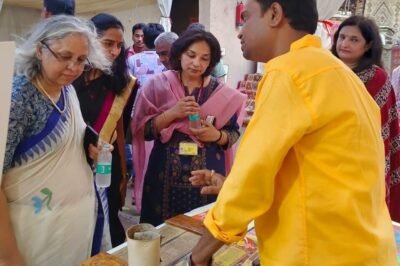
A centuries-old manuscript painting tradition from Assam earns national recognition at the 65th Lalit Kala National Exhibition
NAGAON, ASSAM — A remarkable chapter has been added to Assam’s rich artistic history as celebrated artist Sujit Das’s Dashavatar has been selected for the prestigious 65th Lalit Kala National Exhibition, organised by the Lalit Kala Akademi at the National Gallery of Modern Art, New Delhi.
The recognition marks a significant moment not only for Das but also for Puthi Chitra, Assam’s traditional manuscript-painting tradition, which is now finding a prominent place on the national contemporary art stage.
Created on Sanchipat, a traditional writing and painting material prepared from the bark of the agar tree, Puthi Chitra represents a fascinating meeting point of literature, spirituality, mythology and visual art. For centuries, Assamese artists have used this distinctive medium to illustrate sacred and literary manuscripts, including works associated with the Ramayana, Mahabharata, Bhagavad Gita and devotional literature.
Das’s Dashavatar brings this heritage into contemporary national visibility. The artwork portrays the ten incarnations of Lord Vishnu, combining mythology with the distinctive visual vocabulary of Assam’s manuscript-art tradition. Its carefully rendered figures, characteristic lines, compositions, decorative elements and narrative treatment reflect the artistic grammar that has evolved around Puthi Chitra over generations.
The selection is particularly significant because Puthi Chitra is far more than a painting technique. It is a visual archive of Assam’s cultural memory—a tradition in which stories were not merely written but also brought alive through colour, symbolism and meticulously crafted imagery.
The national exhibition, inaugurated on 21 August, brought together artists and art practitioners from across the country. The inauguration ceremony was attended by Union Minister for Culture Gajendra Singh Shekhawat, Minister of State for Culture Rao Inderjit Singh, and senior officials including Vivek Agarwal, Secretary, Ministry of Culture, and K.K. Mishra, Joint Secretary, Ministry of Culture. The exhibition was also described as an important platform for celebrating India’s diverse artistic traditions.
The recognition of Dashavatar comes at a time when traditional Indian art forms are increasingly being rediscovered and presented within contemporary cultural spaces. The inclusion of Puthi Chitra in such a prestigious national exhibition underscores its artistic depth and its continuing relevance.
For Sujit Das, whose artistic journey spans more than 25 years, the achievement is the culmination of a sustained commitment to preserving, documenting and promoting Assam’s traditional Puthi Chitra. His work has helped introduce this rare manuscript-art tradition to wider audiences in India and abroad.
What makes the achievement especially meaningful is the manner in which Das has remained rooted in tradition while allowing the art form to communicate with the modern world. His work demonstrates that heritage does not have to remain confined to museums or fragile manuscripts—it can evolve, reach new audiences and participate confidently in the contemporary art discourse.
The selection of Dashavatar therefore represents more than an individual artistic honour. It is a national acknowledgement of Assam’s cultural inheritance and of the remarkable artistic knowledge embedded within Puthi Chitra.
From the bark of the agar tree to the galleries of New Delhi, Sujit Das’s Dashavatar has carried with it a story that spans centuries—a story of faith, craftsmanship, imagination and cultural continuity.
Assam’s traditional Puthi Chitra has entered the national art stage, and with it, an ancient artistic voice is once again being heard across India.





Leave a Reply