
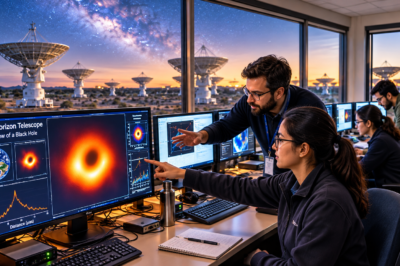
Humanity’s understanding of the universe has taken a remarkable leap forward through the first-ever direct imaging of a black hole, achieved by the international Event Horizon Telescope (EHT) collaboration in 2019. The historic image revealed the shadow of the supermassive black hole at the centre of the Messier 87 (M87) galaxy, approximately 55 million light-years from Earth. Contributions from researchers and scientific institutions around the world, including Australia, demonstrate the importance of international cooperation in advancing modern astrophysics.
The achievement was made possible through a global network of radio telescopes working together using a technique known as Very Long Baseline Interferometry (VLBI). This technology enables geographically separated observatories to function like a virtual telescope the size of Earth, producing extraordinary resolution. Advanced data processing, sophisticated algorithms and powerful supercomputing facilities are essential for interpreting the enormous volume of information collected during observations.
The image does not show the black hole itself, since its gravitational pull prevents even light from escaping. Instead, it reveals a bright ring of radiation emitted by extremely hot gas surrounding the black hole, with a dark central region representing its shadow. The uneven brightness of the ring is associated with the movement of matter at immense speeds and the effects of gravity on light.
The observations also provided an important opportunity to test Albert Einstein’s General Theory of Relativity under extreme gravitational conditions. The findings were broadly consistent with theoretical predictions, strengthening scientific understanding of black holes and their surrounding environments.
Australia’s astronomical research community contributes expertise in radio astronomy, data analysis and advanced computing, supporting the wider international effort to explore the universe. Such scientific collaboration highlights how knowledge and technology developed across different countries can jointly overcome extraordinary research challenges.
Looking ahead, scientists are working towards more detailed observations of black holes, including studies of their changing environments, magnetic fields and powerful jets of matter. The possibility of capturing time-dependent images could provide deeper insights into these mysterious cosmic objects.
The first black hole image was not merely a technological achievement; it opened a new window into the universe and demonstrated that global scientific cooperation can transform what was once invisible into observable scientific evidence.






Leave a Reply