
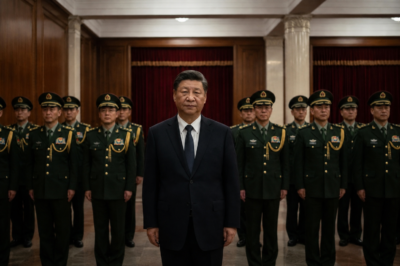
Beijing’s expanding crackdown on corruption inside the People’s Liberation Army (PLA) is increasingly raising questions about the future of China’s military leadership and its approach to the disputed Himalayan frontier with India.
President Xi Jinping’s campaign to tighten political discipline within the armed forces has reached senior commanders and strategic institutions that have played prominent roles in China’s military posture along the Line of Actual Control (LAC). The scrutiny assumes particular significance because the Western Theater Command oversees China’s military operations along the Indian frontier, including areas associated with the 2017 Doklam standoff and the 2020 Galwan Valley clash.
The developments point to more than an ordinary personnel reshuffle. They reflect Xi’s continuing effort to ensure that the PLA remains firmly subordinate to the Communist Party leadership and personally aligned with the political priorities of the central leadership.
A Deepening Shake-Up at the Top
Since assuming power, Xi has repeatedly warned that corruption poses a serious threat to China’s military ambitions. His campaign has targeted senior officers across several branches, including the Rocket Force and military procurement establishments.
The disappearance, investigation or removal of senior commanders has generated considerable speculation about the underlying reasons. Official Chinese statements generally emphasize disciplinary violations or corruption, while outside analysts have also examined the possibility of factional struggles and concerns over political loyalty.
The Western Theater Command is especially important because of its responsibility for China’s vast western borders. Any substantial change in its senior leadership therefore has consequences beyond Beijing’s internal politics.
From Doklam to Galwan
The importance of the current developments cannot be separated from the history of India-China tensions.
The 2017 Doklam confrontation lasted 73 days and brought Indian and Chinese forces into a prolonged standoff near the India-Bhutan-China trijunction. Three years later, the Galwan Valley clash resulted in fatalities on both sides and became the most serious military confrontation between India and China in decades.
Chinese commanders associated with these episodes were once portrayed in official narratives as defenders of national sovereignty. Their subsequent scrutiny illustrates the changing political environment inside the PLA: battlefield prominence does not necessarily guarantee continued political protection.
However, there is insufficient public evidence to conclude that individual commanders independently drove China’s border policy or that the Doklam and Galwan confrontations were primarily products of factional ambitions. Such claims remain matters of analysis and speculation rather than established fact.
Xi’s Centralization of Military Power
The broader transformation of the PLA under Xi is unmistakable. The Chinese president has sought to eliminate corruption, strengthen ideological discipline and improve the military’s ability to conduct modern warfare.
The campaign has also exposed vulnerabilities within China’s military procurement system. Investigations involving senior officials have raised questions about whether corruption, patronage and poor oversight could undermine the quality of weapons, equipment and military infrastructure.
This creates a difficult balance for Xi. Removing compromised officials may strengthen institutional discipline, but repeated leadership turnover can also disrupt command continuity and reduce the willingness of officers to take independent decisions.
What It Means for India
For India, changes inside China’s Western Theater Command deserve close attention.
A leadership transition could temporarily affect operational continuity along the LAC as new commanders establish authority and priorities. At the same time, there is no guarantee that new commanders will adopt a softer approach toward India. Officers seeking to demonstrate loyalty to Beijing could instead pursue a more assertive posture.
The most important question is therefore not whether the PLA is becoming weaker, but whether Xi’s restructuring will make it more centralized, disciplined and politically responsive.
India cannot base its security planning on assumptions of instability inside the Chinese military. Instead, the developments underline the importance of sustained military preparedness, intelligence monitoring, infrastructure development and diplomatic engagement.
The Modernization Dilemma
China has invested enormous resources in transforming the PLA into a technologically advanced fighting force. Its progress in missiles, naval power, aerospace capabilities, surveillance systems, cyber operations and artificial intelligence has attracted worldwide attention.
Yet sophisticated military hardware ultimately depends on effective leadership and reliable institutions.
Xi’s campaign therefore presents a paradox. Anti-corruption measures may improve procurement standards and eliminate entrenched patronage networks, but excessive political pressure and uncertainty among commanders could discourage initiative and risk-taking.
For a military preparing for complex, high-speed conflict, the ability of commanders to make timely decisions can be as important as the weapons they control.
A PLA Increasingly Defined by Loyalty
The continuing shake-up demonstrates the extent to which political loyalty has become central to Xi Jinping’s conception of military power.
The PLA is not simply China’s national armed force; it is the armed wing of the Communist Party. Xi has repeatedly emphasized that the military must remain under absolute Party leadership.
The fate of senior commanders associated with major episodes on the India-China frontier therefore carries a broader message: operational achievements cannot permanently shield PLA officers from political scrutiny.
For India and the wider international community, the most significant issue will be what emerges from this restructuring. A more politically controlled PLA could become more predictable in some circumstances—or more assertive if commanders compete to demonstrate loyalty.
The purge, therefore, should not be viewed merely as an internal Chinese affair. It is part of a larger transformation of the PLA that could influence China’s military behaviour, including along the Himalayan frontier, for years to come.





Leave a Reply