
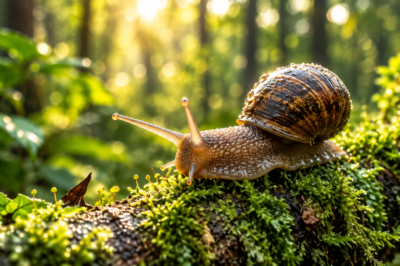
Nature often solves biological problems in ways that continue to challenge modern science. Among the most fascinating examples are certain gastropods whose ability to regenerate damaged ocular structures has attracted scientific interest. Their remarkable biology offers researchers a natural model for understanding how complex tissues can be repaired and reorganised after injury.
For humans, serious damage to the retina or optic nerve can result in lasting loss of function because our regenerative capacity is limited. In regenerative animals, however, injury can trigger a carefully coordinated sequence in which cells multiply, acquire specialised identities and become organised into functional tissues. The process involves not merely closing a wound, but rebuilding biological structures and reconnecting them with the nervous system.
Scientists are particularly interested in the molecular language behind this process. Growth factors, genes, signalling molecules and the extracellular matrix help determine when cells divide, where they move and what they ultimately become. Pathways such as Wnt and Notch, which are involved in cellular development across many organisms, are among the systems being studied for their role in regeneration.
The implications could eventually extend to human ophthalmology. Insights from regenerative organisms may contribute to research into retinal repair, optic-nerve regeneration, tissue engineering and controlled cellular reprogramming. Such possibilities are especially relevant to conditions involving irreversible loss of specialised ocular cells. However, these applications remain scientific possibilities rather than established medical treatments.
One of the greatest challenges is controlling regeneration safely. The biological processes that encourage cells to multiply can also, if improperly regulated, contribute to abnormal growth. Any future human therapy would therefore need precise control over which cells are affected, when regenerative pathways are activated and when they are switched off.
The true importance of the snail lies not in the promise of an immediate cure, but in the questions it raises: How do cells know what to become? How does an injured organism determine what is missing? And how can newly formed tissues reconnect with the nervous system?
The answers could ultimately broaden our understanding of healing itself. The humble snail demonstrates that nature may contain biological solutions to problems that seem extraordinarily difficult from a human perspective. By decoding these regenerative mechanisms, science may gradually move closer to a future in which damaged tissues are not only repaired—but potentially taught to regenerate.






Leave a Reply