
By Pankaj Kumar Sharma
Golaghat | 13 October 2026
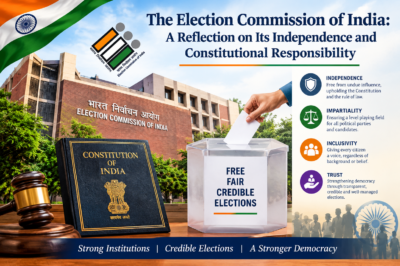
The independence of the Election Commission of India is fundamental to the country’s democratic system. The Commission was established to ensure that elections are conducted fairly, impartially and free from government interference. However, recent controversies surrounding the appointment of Election Commissioners and the Special Intensive Revision (SIR) of electoral rolls have raised serious questions about the institution’s autonomy and public credibility.
Historical Foundations of an Independent Election Commission
Following independence, India’s first Prime Minister, Jawaharlal Nehru, recognised the importance of establishing an independent electoral authority so that the people could elect their representatives without political interference. Discussions involving Nehru and Dr. B. R. Ambedkar, Chairman of the Drafting Committee of the Constitution, contributed to the constitutional framework under Article 324, which provides for the superintendence, direction and control of elections.
The Election Commission of India was established on 25 January 1950, shortly before the Constitution came into force. Sukumar Sen, an experienced Indian Civil Service officer and distinguished mathematician, became the country’s first Chief Election Commissioner. His administrative competence and impartial approach were instrumental in preparing electoral rolls for the newly independent nation.
Although Nehru was keen to hold elections as soon as possible, Sen insisted that adequate time was necessary to establish a reliable electoral system. The preparation of electoral rolls for approximately 173 million people was a monumental undertaking. Consequently, India’s first general election was held in 1951–52, laying the foundation for the world’s largest democratic exercise.
Evolution of the Election Commission
For several decades, the Election Commission functioned as a single-member body. In 1989, additional Election Commissioners were appointed, and the question of strengthening the Commission’s institutional structure gained prominence.
Subsequently, the Dinesh Goswami Committee examined electoral reforms and recommended a three-member Commission to distribute responsibilities and strengthen decision-making. In 1993, the government formalised the three-member structure, consisting of the Chief Election Commissioner and two Election Commissioners.
For many years, the Commission was widely regarded as an important constitutional institution responsible for conducting elections independently of the political executive.
The 2023 Appointment Law and Concerns Over Autonomy
A major debate emerged following the enactment of the Chief Election Commissioner and Other Election Commissioners (Appointment, Conditions of Service and Term of Office) Act, 2023.
Under the new law, the selection committee comprises the Prime Minister, a Union Cabinet Minister nominated by the Prime Minister, and the Leader of the Opposition in the Lok Sabha. Previously, the Supreme Court had prescribed an interim selection arrangement that included the Prime Minister, the Leader of the Opposition and the Chief Justice of India until Parliament enacted a law.
Critics argue that replacing the Chief Justice of India with a minister nominated by the Prime Minister gives the Union Government greater influence over appointments. In their view, this arrangement raises concerns about the institutional independence of an authority that must remain impartial while conducting elections involving the ruling party itself.
The central question is whether the appointment mechanism provides sufficient safeguards to ensure that the Election Commission remains independent in both its decisions and public perception.
Special Intensive Revision and Electoral Transparency
The Special Intensive Revision of electoral rolls has become another major source of controversy. According to the article, large numbers of voters have been removed from electoral rolls in several states, prompting allegations that the exercise could disenfranchise eligible citizens.
The author cites figures relating to states such as Maharashtra, Uttar Pradesh, Karnataka, Tamil Nadu, Gujarat, Telangana and Delhi, and raises concerns about the possible consequences of large-scale deletions. The article also draws attention to constituencies where the reported number of deleted voter entries exceeded the eventual victory margins of prominent political leaders.
These comparisons raise important questions about the need for transparency, accurate documentation and effective grievance-redressal mechanisms during electoral roll revision. However, the number of deletions alone does not establish that the process was politically motivated or that any particular election result was affected. Such allegations require independent examination of the underlying records and the reasons for each deletion.
The right to vote is central to representative democracy. Therefore, every eligible citizen must have a fair opportunity to remain on the electoral roll, verify their registration and seek correction or restoration when an error occurs.
Accountability and Public Confidence
One of the article’s principal concerns is the apparent gap between allegations against the Election Commission and the political responses to those allegations. The author questions why the ruling party appears to be responding to criticism directed at an independent constitutional institution.
This concern highlights a broader democratic principle: constitutional institutions must be able to explain their decisions transparently and defend their credibility through evidence, procedures and accountability. Political parties may express their views, but the Commission itself must communicate clearly about the methods adopted, the grounds for voter deletions and the safeguards available to affected citizens.
Equally, allegations of bias should be investigated through verifiable evidence rather than treated as established facts without examination. Institutional independence requires both freedom from political interference and a demonstrable commitment to fairness.
Conclusion
The Election Commission of India is not merely an administrative extension of the Union Government; it is a constitutional institution entrusted with safeguarding the electoral process. Its authority ultimately rests on public confidence that every eligible voter can exercise their democratic right and that every political party competes under impartial rules.
The historical legacy of Sukumar Sen and the constitutional vision underlying Article 324 underline the importance of preserving this independence. Contemporary debates over appointment procedures and electoral roll revisions make transparency, accountability and impartiality more important than ever.
India’s democracy will remain strong only when its electoral institutions command the confidence of citizens across political affiliations. Protecting the autonomy of the Election Commission is therefore not simply a matter of administrative reform; it is essential to preserving the integrity of elections and the foundations of the Indian Constitution.






Leave a Reply