
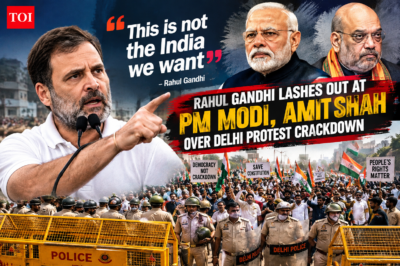
The recent handling of protests in New Delhi has intensified political debate over the balance between public order and democratic freedoms. Congress leader Rahul Gandhi has criticised Prime Minister Narendra Modi and Union Home Minister Amit Shah, describing the situation as “not the India we want.” His remarks reflect the opposition’s concerns about the treatment of protesters and the space available for peaceful dissent in the country.
According to the account, demonstrations by civil society groups and political organisations were met with extensive security arrangements, including barricades, fencing and police deployment. Detentions and the reported use of force further fuelled criticism. Gandhi argued that the authorities should respond to citizens’ grievances through dialogue rather than excessive restrictions. He maintained that a democratic government must respect the right of people to express disagreement peacefully.
Rahul Gandhi’s Vision of an Inclusive India
A central element of Gandhi’s criticism is the idea of two contrasting Indias. He argues that influential sections of society enjoy greater protection and opportunities, while farmers, workers and young people face economic difficulties and policies they consider unfavourable. Through the phrase “not the India we want,” he seeks to highlight his vision of a society founded on equality, pluralism, tolerance and constitutional values.
Gandhi has presented the developments in Delhi as part of a wider concern about the treatment of political opposition and public criticism. By holding the central leadership accountable, he has emphasised the importance of freedom of speech and peaceful assembly, rights protected under Article 19 of the Indian Constitution, subject to constitutional restrictions.
Government’s Security Concerns and the Opposition’s Response
The issue has also drawn attention to the administrative position of Delhi Police, which functions under the Union Home Ministry. Consequently, security measures in the capital often become a subject of direct political debate. Critics view strict barricading and detentions as measures that could discourage public demonstrations. The government’s position, as described in the account, is that firm security arrangements may be necessary to prevent violence, maintain public order and protect the functioning of the capital.
The disagreement therefore centres on how authorities should manage protests while safeguarding citizens’ democratic rights. Supporters of stricter measures emphasise security, whereas opponents argue that peaceful criticism should not be treated as a threat.
Implications for Indian Democracy
The controversy has wider implications for public confidence in democratic institutions. Concerns about restrictions on activists, freedom of expression and the treatment of dissent have become important elements of political discussion. Such developments can also influence India’s international image as a democratic nation.
Ultimately, the situation highlights the need for constructive engagement between the government, opposition parties and citizens. Democracy involves more than periodic elections; it also requires accountability, respect for constitutional freedoms and opportunities for peaceful disagreement. A balanced approach that protects public order while allowing legitimate protest can strengthen democratic institutions and public trust.
The debate over Delhi’s protests is therefore not simply a political confrontation. It raises a fundamental question about the kind of India its citizens aspire to build—one in which security and stability coexist with liberty, inclusion and respect for democratic principles.






Leave a Reply