
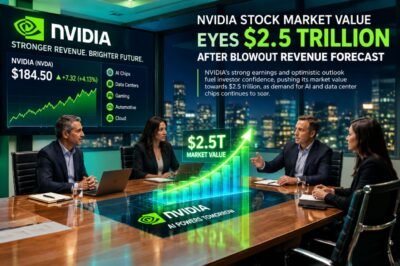
Nvidia Corporation has emerged as one of the most influential companies in the global technology industry, transforming itself from a graphics-card manufacturer into a leading force behind the artificial intelligence (AI) revolution. Its impressive financial performance and strong revenue outlook have strengthened investor confidence, bringing its market valuation closer to the historic $2.5 trillion milestone. This growth reflects the rising demand for advanced computing infrastructure and generative AI technologies, positioning Nvidia at the centre of a major transformation in the digital economy.
The company’s latest earnings performance has been driven largely by its data centre business and strong demand for advanced AI processors, including the H100 and H200. Robust revenue growth, high profit margins and optimistic future projections have reinforced expectations that investment in AI infrastructure will continue expanding. Under CEO Jensen Huang’s leadership, Nvidia has also focused on developing its next-generation Blackwell architecture, designed to deliver greater computing performance and improve efficiency in handling complex AI workloads.
Another important factor behind Nvidia’s dominance is its comprehensive data centre strategy. Beyond manufacturing chips, the company provides networking technologies, software platforms and integrated computing solutions that enable thousands of processors to operate together. Major cloud service providers, specialised AI companies and governments investing in national AI infrastructure are contributing to this growing market.
Nvidia’s CUDA software ecosystem further strengthens its competitive position. A large community of developers relies on its tools and platforms, making it difficult for competitors to replicate the complete combination of hardware, software and networking capabilities. Its enterprise AI solutions also create opportunities to expand beyond chip sales into higher-value software services.
The company’s rising market capitalisation has significantly influenced major stock market indices, including the S&P 500 and Nasdaq-100. Although strong earnings and cash generation support investor optimism, questions about valuation, competition and the sustainability of AI investment remain important. Geopolitical tensions, export restrictions and possible supply-chain disruptions also pose risks.
Looking ahead, opportunities in robotics, autonomous vehicles and edge computing could further expand Nvidia’s business. Its progress towards a multi-trillion-dollar valuation will depend on continued innovation, sustained demand and its ability to manage emerging challenges. Nvidia’s journey illustrates how advanced semiconductors and integrated AI technologies are reshaping the global economy, making the company a key player in the next era of computing.







Leave a Reply