
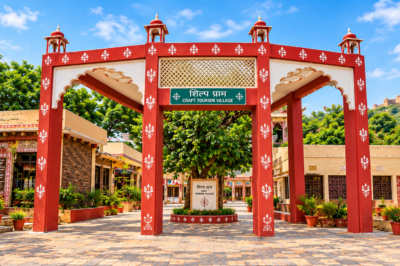
The Office of the Development Commissioner (Handicrafts), Ministry of Textiles, Government of India, has introduced the concept of Craft Villages to create a meaningful convergence between handicrafts, tourism and sustainable livelihoods. A Craft Village is envisioned as a living destination where artisans reside, produce, demonstrate and sell their traditional crafts, enabling visitors to experience authentic craftsmanship while providing artisans with direct access to markets.
Under the initiative, financial assistance is provided for developing infrastructure such as artisan houses and worksheds, roads, water supply, sewerage, street lighting, footpaths, shops and display areas. The objective is to establish craft destinations that can be integrated with existing tourist circuits and generate sustainable economic opportunities for artisan communities.
With a view to promoting Rajasthan’s rich handicraft traditions, the Government of India sanctioned a Craft Tourism Village at Kunda, Amer, Jaipur, under the Office of the Development Commissioner (Handicrafts). Sanctioned during 2020–21, the project has a total cost of approximately ₹5.37 crore, comprising a Government of India share of ₹4.12 crore and an implementing-agency share of ₹1.25 crore. The project has been implemented by the Jaipur Development Authority and presently covers around 40 houses.
Kunda possesses considerable potential to become a prominent craft-tourism destination. Visitors can experience live demonstrations, interact directly with artisans, understand traditional techniques and purchase authentic handcrafted products. Such direct engagement can improve artisan earnings while reducing dependence on intermediaries.
However, creating infrastructure is only the first step; converting that infrastructure into a commercially successful destination is the larger challenge. A substantial public investment should be followed by a professionally designed business, tourism and marketing strategy to ensure that the facility remains vibrant, productive and financially sustainable.
Jaipur is already one of India’s major tourist destinations. During the first half of 2026, Jaipur reportedly recorded more than 81 lakh tourist visits, including over 2.56 lakh foreign tourist visits, providing a substantial potential customer base for the Craft Tourism Village. Rajasthan as a whole also attracts millions of domestic and international visitors every year.
Jaipur has emerged as a major economic and export hub of Rajasthan, with an annual export value exceeding ₹1 lakh crore, supported by a strong base of approximately 12 lakh Micro, Small and Medium Enterprises (MSMEs). The city has significant export strength in key sectors such as gems and jewellery, textiles and handicrafts, providing a well-established ecosystem of manufacturers, artisans, traders, exporters and international buyers. In the wider state context, Rajasthan’s total exports have reached around ₹97,171.68 crore, with Jaipur playing a prominent role in the State’s trade and commercial activities. This robust export ecosystem presents a significant opportunity for the Craft Tourism Village, Kunda, to establish linkages with exporters, international buyers, trade bodies and e-commerce platforms, thereby connecting local artisans and traditional crafts with national and global markets.
This existing tourism ecosystem should be strategically connected with Kunda. The Craft Tourism Village should be developed as a recognisable craft brand and destination, rather than functioning merely as an infrastructure facility.
A comprehensive Kunda Craft Tourism Business Plan could include a dedicated annual calendar of craft festivals, weekend artisan demonstrations, curated exhibitions, cultural performances, live workshops, school and college visits, international buyer programmes, design showcases and seasonal craft bazaars. A fixed annual flagship event could establish Kunda as a destination on Jaipur’s tourism calendar.
Digital promotion should be another major pillar. Professional social-media campaigns, high-quality audiovisual storytelling, influencer collaborations, travel bloggers, tour operators and online marketplaces can introduce Kunda’s crafts to domestic and international audiences. Every craft should be presented through its story, heritage, geographical identity, craftsmanship, artisan and cultural significance.
The village should also establish strong linkages with hotels, tour operators, airports, railway stations, museums, heritage properties, international buyers, export promotion organisations and e-commerce platforms. QR-based product information, digital payments, online catalogues and linkages with platforms such as IndiaHandmade can further strengthen market access.
The Craft Tourism Village could also become a centre for skill development, design innovation, packaging, branding, quality improvement and entrepreneurship, enabling artisans to move from traditional production towards sustainable enterprise.
Rajasthan has a large artisan base, with more than 1.85 lakh artisans enrolled under PEHCHAN initiatives of the Office of the Development Commissioner (Handicrafts). Jaipur itself is a major commercial and export centre with strong linkages in gems and jewellery, textiles and handicrafts. This ecosystem provides an exceptional opportunity to connect local artisans with tourism and global markets.
Therefore, the next phase of Kunda should move from “infrastructure creation” to “business creation.” A dedicated management mechanism, annual business targets, visitor targets, marketing strategy, event calendar, artisan participation plan and measurable revenue indicators should be developed.
The objective should be clear: Kunda must not become merely a collection of buildings and stalls. It should become a living, commercially vibrant Craft Tourism Hub where tourists come to experience, artisans come to earn, buyers come to source and Rajasthan’s craftsmanship reaches the world.
Public investment in such infrastructure can generate substantial social and economic returns only when the facilities are continuously utilised, promoted and commercially activated. Timely intervention can prevent valuable infrastructure from becoming underutilised and ensure that Kunda evolves into a sustainable model for craft-led tourism, artisan entrepreneurship and cultural heritage preservation.
Suggested Vision
“Kunda Craft Tourism Village — Where Heritage Meets Livelihood, Craft Meets Tourism, and Rajasthan’s Artisans Connect with the World.”
The Office of the Development Commissioner (Handicrafts) has been making significant efforts for the welfare, development and economic empowerment of artisans across the country. However, the creation of infrastructure alone cannot ensure long-term benefits unless such facilities are properly utilised and supported by a clear, sustainable and commercially viable business plan.
There is a need to shift the focus from merely establishing infrastructure to ensuring its effective utilisation, continuous activation and revenue-generating potential. Craft Villages and similar facilities should be developed as vibrant centres of production, demonstration, tourism, marketing and entrepreneurship, enabling artisans to establish sustainable businesses and access national as well as international markets.
If valuable infrastructure remains underutilised for a prolonged period, there is a risk of deterioration, encroachment, or conversion into an unproductive space. Such an outcome would defeat the very purpose for which substantial public resources have been invested.
Therefore, the Office of the DC(Handicrafts) may consider undertaking a comprehensive review of existing craft-related infrastructure and preparing location-specific business and operational plans. These plans could include annual events, tourism promotion, professional marketing, digital platforms, buyer-seller meets, exhibitions, branding, partnerships with tour operators and hotels, and linkages with domestic and international markets.
The objective should be to transform existing infrastructure into self-sustaining economic assets for artisans. With proper planning, professional management and continuous promotion, these facilities can generate employment, increase artisan incomes, attract tourists and buyers, and ultimately create sustainable revenue streams.
The priority should now be not only to build infrastructure, but to make every infrastructure asset work for the artisan.






Leave a Reply