
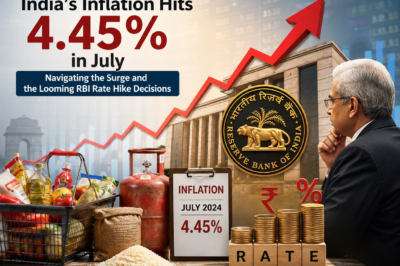
New Delhi: India’s retail inflation has accelerated to 4.45% in July, marking a notable shift from the relatively softer price trends witnessed earlier. The latest Consumer Price Index (CPI) reading has renewed concerns among economists, consumers and investors over the persistence of inflationary pressures and has intensified speculation about the future course of monetary policy by the Reserve Bank of India (RBI).
The rise in inflation is being attributed largely to higher food prices, particularly vegetables, pulses and cereals. Disruptions caused by uneven monsoon conditions have affected agricultural supply chains in several regions, pushing up the prices of essential commodities. Rising transportation and input costs have also added pressure to household budgets.
RBI Faces a Difficult Policy Choice
The latest inflation reading presents a challenging equation for the RBI. While monetary tightening can help contain price pressures, higher interest rates can simultaneously increase borrowing costs for households and businesses, potentially slowing investment and consumption.
The central bank’s focus remains on bringing inflation closer to its medium-term 4% target while ensuring that economic growth remains resilient. If inflation continues to remain elevated in the coming months, expectations of a possible repo-rate increase could gain further momentum.
Global Factors Add to the Pressure
India’s inflation outlook is also influenced by global developments. International crude oil prices, currency movements and monetary policy decisions by major central banks can affect domestic prices. A weaker rupee, for instance, can increase the cost of imported commodities such as crude oil and electronic goods.
Impact on Households
For ordinary households, rising inflation is most visible in monthly grocery bills and essential expenses. Any future increase in interest rates could also raise EMIs on home, automobile and personal loans, adding further pressure on middle-class families.
Outlook
The trajectory of inflation in the coming months will depend significantly on monsoon conditions, food production, commodity prices and government supply-side measures. A sustained moderation in food and core inflation could ease pressure on the RBI. However, if price pressures remain persistent, monetary tightening may once again come into focus.
For policymakers, the challenge is clear: control inflation without compromising India’s growth momentum. The next few months will therefore be crucial in determining whether the July inflation spike proves temporary or signals a more prolonged period of price pressure.






Leave a Reply