
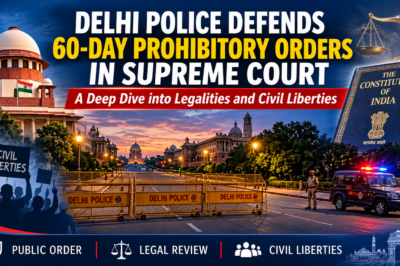
The recurring imposition of 60-day prohibitory orders by the Delhi Police has emerged as a significant legal and constitutional issue, drawing the attention of the Supreme Court of India. The police have defended these ex-parte restrictions as necessary preventive measures to maintain public order and safeguard sensitive locations, including Parliament, Rashtrapati Bhavan, diplomatic enclaves and important government installations.
The controversy primarily concerns the repeated use of prohibitory powers under Section 144 of the erstwhile Code of Criminal Procedure, now replaced by the Bharatiya Nagarik Suraksha Sanhita (BNSS). While the authorities contend that the sensitive nature of the national capital and the possibility of sudden mobilization through social media justify such measures, concerns have been raised regarding their prolonged and routine application.
Critics argue that recurring restrictions may adversely affect the fundamental right to peaceful assembly and freedom of expression. Such orders may create a chilling effect on legitimate protests, particularly for students, activists and marginalized groups. Their impact may also extend to businesses, public movement and the overall democratic character of the capital.
The Supreme Court’s scrutiny emphasizes the need to ensure that preventive restrictions are based on concrete facts, imminent threats and the principle of proportionality. Judicial precedents, including Anuradha Bhasin v. Union of India, underline that restrictions on fundamental rights must be reasonable, necessary and proportionate.
A balanced approach to urban security is therefore essential. Instead of blanket prohibitions, authorities may consider event-specific restrictions, intelligence-based security assessments, transparent review mechanisms and improved crowd-management strategies.
The ongoing legal debate has wider implications for democratic governance across India. Its outcome may establish important parameters for the exercise of preventive police powers, ensuring that public security is maintained without unnecessarily curtailing citizens’ constitutional freedoms. Ultimately, the challenge lies in preserving Delhi’s security while protecting its identity as a vibrant democratic capital where peaceful dissent remains an essential constitutional right.






Leave a Reply