
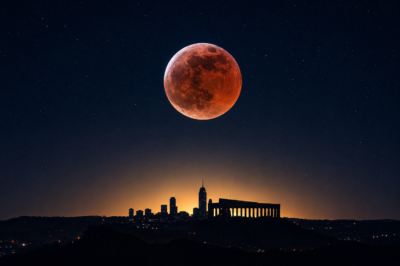
March 3, 2026, promises a remarkable celestial spectacle as the Moon turns deep red during a total lunar eclipse
The night sky over the United States is set to become the backdrop for one of nature’s most fascinating astronomical events—a total lunar eclipse on March 3, 2026. Often described as a “Blood Moon,” the event will occur when the Earth moves directly between the Sun and the Moon, causing its shadow to gradually cover the lunar surface.
Unlike a solar eclipse, a lunar eclipse can be observed safely with the naked eye. During totality, the Moon is expected to acquire striking shades of copper, orange and red, creating a dramatic sight for skywatchers across large parts of the country.
Why Does the Moon Turn Red?
The reddish appearance is caused by Earth’s atmosphere. As sunlight passes through the atmosphere, blue wavelengths are scattered more strongly, while red and orange wavelengths are bent toward the Moon. The same atmospheric phenomenon is responsible for the colours seen during spectacular sunrises and sunsets.
The intensity of the red colour can vary depending on atmospheric conditions, including dust, pollution and volcanic particles.
A Show Unfolding in Five Stages
The eclipse will progress gradually through several stages. It begins with the penumbral phase, when the Moon enters the lighter portion of Earth’s shadow. This is followed by the partial eclipse, as the Moon moves into the darker umbra.
The highlight arrives with totality, when the entire lunar disk is immersed in Earth’s shadow. The Moon then slowly emerges through the partial and penumbral phases, bringing the spectacle to an end.
Best Places to Watch
Observers in the western United States are expected to have favourable conditions for viewing the complete sequence. Locations away from city lights, including dark-sky areas and national parks, could provide especially impressive views.
For photographers, a tripod, telephoto lens and remote shutter are recommended. Shooting in RAW format can also help preserve the subtle colours and details of the eclipsed Moon.
More Than a Visual Spectacle
The 2026 Blood Moon is more than an astronomical show. Lunar eclipses have fascinated civilizations for centuries, inspiring myths, scientific observations and cultural traditions.
Today, such events provide an opportunity for families, students, amateur astronomers and professional researchers to observe celestial mechanics directly. With renewed global interest in lunar exploration, the eclipse also offers a timely reminder of humanity’s enduring relationship with Earth’s nearest celestial neighbour.
As the Moon disappears into Earth’s shadow and emerges glowing crimson, March 3, 2026, promises to be a memorable night for astronomy enthusiasts across the United States.






Leave a Reply