
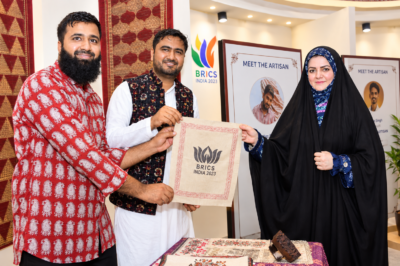
The BRICS Bazaar 2026 at the National Crafts Museum & Hastkala Academy, New Delhi, became a remarkable meeting point of heritage, craftsmanship and international friendship, offering visitors a vivid glimpse into the richness of India’s living handicraft traditions. Among the many memorable moments of the event was the special interaction between Zahra Pezeshkian, daughter of the President of Iran, and National Award-winning Bagh print artisan Bilal Khatri, which brought Madhya Pradesh’s celebrated traditional craft into the international spotlight.
Zahra Pezeshkian visited Khatri’s stall and showed keen interest in the centuries-old Bagh printing tradition. She observed the intricate process through which the craft’s distinctive red-and-black patterns are created and learned about the traditional techniques and natural colouring methods that give Bagh print its exceptional character and enduring appeal.
The encounter reached a symbolic high point when Zahra Pezeshkian personally used a traditional wooden block to stamp the BRICS India 2026 logo. This simple yet powerful gesture created a beautiful bridge between India’s traditional craftsmanship and the contemporary spirit of international cooperation. It demonstrated that art and culture can communicate across borders without the need for language.
As a gesture of warmth and hospitality, Bilal Khatri presented her with an elegant silk-cotton stole decorated with traditional Bagh motifs. The exchange reflected mutual appreciation and showed how Indian handicrafts can become ambassadors of friendship between nations.
The BRICS Bazaar was not limited to one craft or one artisan. Award-winning master craftspersons from across India participated in the event, demonstrating their specialised skills, techniques and craftsmanship before delegates, international visitors, buyers and the general public. Their live demonstrations offered audiences an opportunity to witness the patience, precision and creativity involved in transforming traditional knowledge into beautiful handcrafted products.
For many visitors, these demonstrations became an unforgettable cultural experience. They provided a closer understanding of India’s diverse craft heritage and highlighted the dedication of artisans who have preserved traditional skills through generations.
The Bazaar also created meaningful opportunities for participating artisans to establish direct business and marketing linkages with visitors, buyers, institutions and international delegates. Such interactions can help artisans expand their markets, strengthen their enterprises and gain greater recognition for both their products and craftsmanship.
For international visitors, the BRICS Bazaar offered more than shopping or sightseeing—it provided a window into India’s cultural identity. The hope is that delegates and visitors returning to their respective countries will carry with them a positive and lasting impression of India’s extraordinary heritage, creativity and hospitality.
The memorable Bagh print interaction therefore represents much more than the appreciation of a traditional textile craft. It was a BRICS moment where heritage met friendship, craftsmanship met diplomacy, and a traditional wooden block became a symbol of international unity.
As India’s artisans continue to demonstrate their skills before the world, such platforms can play an important role in ensuring that traditional crafts remain economically vibrant, culturally respected and relevant for future generations.
When Indian craftsmanship reaches the world, heritage






Leave a Reply