
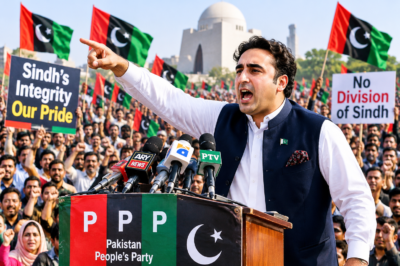
Pakistan’s political landscape is witnessing renewed tensions following a strong warning by Pakistan Peoples Party (PPP) Chairman Bilawal Bhutto Zardari against any attempt to redraw the administrative boundaries of Sindh province. His warning of possible bloodshed in Karachi and Hyderabad reflects the deep-rooted political, ethnic and economic sensitivities surrounding the proposed creation of separate administrative units or a new province.
The controversy centres on demands for greater administrative autonomy for Karachi, Pakistan’s largest metropolitan city and principal economic hub. Supporters of a separate Karachi province argue that independent governance could improve infrastructure, public services, security and resource management. However, the PPP considers such proposals an attempt to weaken Sindh’s territorial integrity and undermine the political and economic interests of its people.
Historically, Sindh has maintained a distinct cultural and linguistic identity, while Karachi and Hyderabad have evolved into multicultural centres with substantial Sindhi-speaking and Urdu-speaking populations. The bitter ethnic conflicts of the 1980s and 1990s remain a reminder of how political disagreements can threaten social harmony.
The economic dimension is equally significant. Karachi contributes substantially to Pakistan’s national revenue and houses its major commercial institutions, financial establishments and seaports. The PPP argues that revenue generated by the city supports development across the entire province.
Constitutionally, Article 239 of Pakistan’s Constitution requires a two-thirds majority in the affected provincial assembly, alongside the prescribed parliamentary approval, for altering provincial boundaries.
Ultimately, the controversy represents a larger challenge to Pakistan’s federal structure and provincial autonomy. Administrative reforms are necessary, particularly for metropolitan governance, but they must emerge through constitutional procedures, political consensus and inclusive dialogue. Pakistan’s stability depends on protecting territorial integrity, preventing ethnic polarization and ensuring peaceful coexistence among its diverse communities.





Leave a Reply