
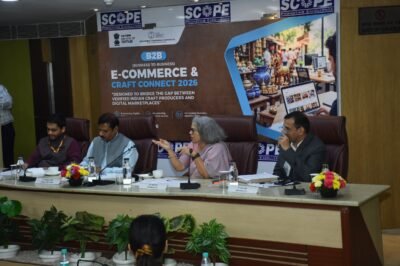
A Significant Initiative Towards Digital Empowerment, Direct Market Linkages and Sustainable Livelihoods for Indian Artisans
The Office of the Development Commissioner (Handicrafts), Ministry of Textiles, Government of India, organised B2B E-Commerce & Craft Connect 2026 on 29 October 2026 at the SCOPE Convention Centre, Lodhi Road, New Delhi. The initiative marked an important step towards connecting India’s traditional handicrafts sector with rapidly expanding digital marketplaces, enabling artisans, Mastercraftspersons, Producer Companies (PCs), Self-Help Groups (SHGs) and craft entrepreneurs to explore new business opportunities through e-commerce platforms.
The programme was conceived as a pilot initiative to address practical difficulties faced by artisans in accessing digital markets, particularly seller registration, documentation, product listing, GST-related requirements and direct interaction with e-commerce companies.
Inauguration and Interaction with Artisans
The event was formally inaugurated by Ms. Amrit Raj, Development Commissioner (Handicrafts), who welcomed the participating artisans, representatives of e-commerce platforms, officials and other dignitaries. In her inaugural address, she encouraged the participants to take full advantage of the opportunity provided by the Department to establish direct connections with digital marketplaces and strengthen their business prospects.
During the programme, the Development Commissioner personally interacted with participating artisans and craft-based organisations to understand their existing engagement with e-commerce platforms, marketing difficulties, documentation-related challenges and expectations from digital marketplaces.
The interaction provided valuable insights into the practical difficulties encountered by traditional craft producers, particularly those who possess exceptional craftsmanship but lack adequate technical knowledge, digital marketing experience and access to organised online markets.
Participation of Leading E-Commerce Platforms
Seven prominent e-commerce platforms, namely Flipkart, MeMeraki, Meesho, Karigariwala, Rooftop, IndiaHandmade and Government e-Marketplace (GeM), participated in the event.
Their representatives interacted directly with artisans, explained platform-specific registration requirements and provided practical assistance with seller registration, submission of documents and onboarding procedures.
The initiative offered a common platform where artisans could showcase their handcrafted products, understand online selling opportunities and explore potential business relationships without depending entirely on traditional intermediaries.
Shri Anuj Ojha, Joint Development Commissioner (Handicrafts), and Shri Virendra Kumar, Regional Director (Handicrafts), played an important role in coordinating the programme and facilitating interactions between participating artisans and e-commerce representatives.
Officers were assigned to guide participants, organise them into groups and facilitate their movement to the respective e-commerce helpdesks, ensuring that registration-related queries and documentation requirements could be addressed effectively.
Encouraging Response and Registration Outcomes
The programme witnessed encouraging engagement from participating artisans and digital marketplace representatives.
According to the feedback received from the seven participating platforms, a total of 310 platform-wise artisan approaches and enquiries, 152 registrations and 153 document submissions were recorded during the event.
Among the participating platforms, GeM recorded the highest engagement, with 80 enquiries, 59 registrations and 59 document submissions. Rooftop recorded 70 enquiries and 35 document submissions, while Meesho and Karigariwala each reported 45 registrations.
Flipkart recorded 28 enquiries, 3 registrations and 19 document submissions. IndiaHandmade received 21 enquiries and 20 document submissions, while MeMeraki interacted with 21 interested artisans.
These outcomes demonstrate the growing interest among traditional craft producers in adopting digital marketing channels and accessing wider consumer markets.
However, the reported figures represent platform-wise engagement and may include artisans interacting with more than one platform. Therefore, further verification is necessary before treating the figures as unique artisan registrations or completed onboarding cases.
The actual impact of the initiative will be better assessed through subsequent seller account activation, product listings, confirmed orders and business transactions.
Key Observations and Future Recommendations
The feedback received from participating platforms highlighted the importance of advance preparation, documentation readiness and sustained coordination for achieving better onboarding outcomes.
It was suggested that relevant details of selected artisans should be shared with participating e-commerce companies in advance to facilitate communication and preliminary scrutiny of registration requirements.
Similarly, virtual interaction sessions between artisans and platform representatives before such events could help resolve technical queries, clarify GST-related requirements and minimise difficulties during the actual registration process.
Another important recommendation concerned advance sharing of product catalogue formats, photography standards, product descriptions and other listing requirements so that artisans could attend future programmes with the necessary documentation and product information.
These measures would help transform one-day registration events into more effective and result-oriented digital market linkage programmes.
Strengthening Artisan Entrepreneurship and Sustainable Livelihoods
India’s handicrafts sector represents an invaluable combination of traditional knowledge, artistic excellence, cultural identity and livelihood opportunities. However, many skilled artisans continue to face difficulties in accessing organised markets, identifying potential buyers and obtaining remunerative prices for their products.
Digital marketplaces can help bridge this gap by enabling artisans and craft-based enterprises to connect directly with customers across India and, where applicable, international markets.
The B2B E-Commerce & Craft Connect initiative demonstrated how government facilitation, institutional coordination and participation by established digital platforms can help traditional artisans overcome procedural barriers and gradually develop independent online businesses.
By encouraging digital entrepreneurship, improving product visibility and facilitating market access, such initiatives can contribute towards increasing artisan incomes, generating employment and strengthening the economic sustainability of traditional craft clusters.
Conclusion
B2B E-Commerce & Craft Connect 2026 represents a meaningful initiative in integrating India’s traditional handicrafts sector with modern digital commerce. The encouraging response from artisans and participating e-commerce platforms highlights the potential for developing stronger and more sustainable market linkages through continued institutional support.
The leadership and participation of the Development Commissioner (Handicrafts), Joint Development Commissioner (Handicrafts) and Regional Director (Handicrafts) reflected the Department’s commitment to facilitating practical solutions for artisans seeking access to digital marketplaces.
The experience gained from this pilot programme can provide a valuable foundation for organising similar initiatives across different regions of the country, supported by advance coordination, structured onboarding assistance and systematic follow-up.
The true success of such initiatives will ultimately be measured not merely by the number of registrations completed, but by the number of artisans who successfully establish online businesses, receive regular orders, increase their earnings and achieve sustainable livelihoods.
By connecting traditional craftsmanship with modern technology, India can create new opportunities for its artisan communities while preserving its rich cultural heritage and advancing the national vision of Digital India, Atmanirbhar Bharat and Viksit Bharat.






Leave a Reply