
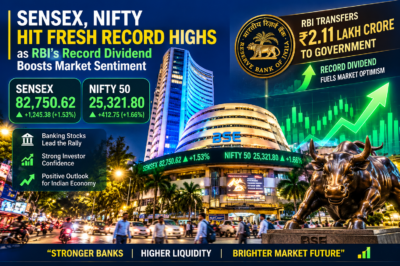
The Indian stock market witnessed a remarkable rally as the benchmark indices, the BSE Sensex and NSE Nifty 50, climbed to unprecedented record levels. The surge followed the Reserve Bank of India’s (RBI) announcement of a record surplus transfer of ₹2.11 lakh crore to the Central Government for the financial year 2023–24, significantly exceeding earlier budget estimates and market expectations.
RBI Dividend Strengthens Government Finances
The substantial transfer is expected to provide the government with greater financial flexibility, creating opportunities to reduce the fiscal deficit or increase spending on infrastructure and development projects. Higher investment in roads, railways and other public infrastructure could stimulate economic activity, support corporate earnings and strengthen investor confidence.
The additional revenue may also reduce the government’s borrowing requirements, potentially easing pressure on bond yields and borrowing costs. These developments have encouraged investors to view India’s economic outlook more positively.
Banking Stocks Drive the Market Rally
Banking and financial services stocks played a significant role in the market’s upward movement. Public sector banks benefited from expectations of improved fiscal stability, while private lenders attracted investors’ attention amid healthy credit growth and improving asset quality. Major companies, including HDFC Bank, ICICI Bank and Reliance Industries, contributed to the broader market momentum.
The rally also extended to mid-cap and small-cap stocks, reflecting wider investor participation and improving market sentiment.
Institutional Investors Support Market Momentum
Domestic Institutional Investors (DIIs), mutual funds and retail investors have continued to support Indian equities through sustained investments, including Systematic Investment Plans (SIPs). The prospect of renewed participation by Foreign Institutional Investors (FIIs) has further strengthened expectations of continued market activity.
India’s economic growth, infrastructure expansion, manufacturing initiatives and increasing domestic consumption remain important factors supporting its appeal to investors.
Outlook: Opportunities Alongside Risks
Despite the record highs, market experts caution that valuations in several sectors may be elevated. Future performance will depend on corporate earnings, inflation, interest rates, crude oil prices, global economic developments and government policy decisions. Short-term corrections and profit-booking cannot be ruled out.
The Sensex and Nifty’s historic performance highlights growing confidence in India’s economic potential. However, sustaining the rally will require strong corporate earnings, fiscal discipline and continued economic growth. Investors should maintain a disciplined, diversified and long-term approach rather than making decisions solely on the basis of market euphoria.







Leave a Reply