
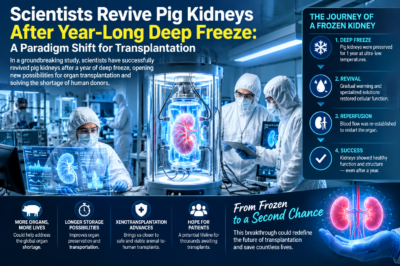
A remarkable development in biomedical research is creating new possibilities for the long-term preservation of transplantable organs. Scientists at the University of Minnesota have demonstrated that pig kidneys can be preserved in a frozen state for an extended period of one year and subsequently revived for transplantation into living animals. This achievement represents an important step towards addressing the global shortage of donor organs and improving the future of transplant medicine.
The breakthrough relies on vitrification, a specialised preservation technique that prevents the formation of destructive ice crystals within biological tissues. By using protective chemical solutions and extremely low temperatures, researchers can place organs in a glass-like state, effectively suspending biological activity. The major challenge, however, lies in restoring the organ without damaging its delicate internal structures.
To address this problem, researchers developed nanowarming, which uses iron oxide nanoparticles distributed throughout the organ. When exposed to an alternating magnetic field, these particles generate heat evenly from within, enabling rapid and controlled warming. Following preservation and revival, the experimental pig kidneys reportedly regained essential functions, including blood filtration and urine production.
Reshaping the Future of Healthcare
The ability to preserve organs for longer periods could revolutionise transplant procedures by reducing the pressure of time-sensitive transportation and minimising the loss of potentially usable organs. In the future, specialised organ banks may enable hospitals to store preserved organs and improve the process of matching donors with suitable recipients.
This technology could also contribute to reducing the long-term healthcare costs associated with kidney failure, particularly where successful transplantation can reduce dependence on dialysis. In addition, improved preservation methods may support ongoing research into xenotransplantation, which explores the use of animal organs for human transplantation.
Challenges and the Way Forward
Despite its considerable promise, further research is necessary before this technology can be applied routinely to human transplantation. Scientists must establish long-term safety and functionality, assess the effects of preservation chemicals and nanoparticles, and meet regulatory requirements. Ethical questions concerning animal welfare, fair access to organs and the risk of cross-species infections must also be addressed.
In conclusion, the successful revival of long-preserved pig kidneys offers encouraging prospects for the development of organ banking. Although substantial scientific and regulatory challenges remain, continued research in vitrification and nanowarming could eventually make transplantation more accessible, efficient and reliable, offering renewed hope to patients awaiting life-saving treatment.






Leave a Reply