
Srinagar | 12 October 2026
Artisans are the backbone of India’s rich handicrafts heritage, dedicating their skills, creativity and hard work to producing unique handcrafted products. Most artisans initially concentrate on sustaining their families through traditional craftsmanship rather than aspiring to become large-scale entrepreneurs. However, those who understand changing market trends, consumer preferences, product durability, eco-friendly practices and quality standards gradually develop the potential to transform themselves into successful entrepreneurs.
Recognising this potential, the Office of the Development Commissioner (Handicrafts), Ministry of Textiles, Government of India, has initiated Entrepreneurship Development Programmes (EDPs) across the country to strengthen entrepreneurial capabilities among artisans and shareholders of handicrafts Producer Companies.
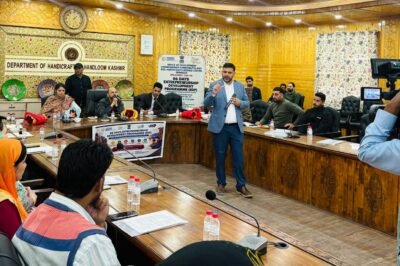
As part of this initiative, the Handicrafts Service Centre, Srinagar, commenced an Entrepreneurship Development Programme on 12 October 2026 at the Conference Hall of the Directorate of Handicrafts and Handloom, Kashmir, under the National Handicrafts Development Programme (NHDP). The programme accommodates 20 young artisans and artisan shareholders of Producer Companies, including participants from Baramulla, Pulwama and Anantnag.
The programme was inaugurated by Shri Mussarat Islam, Director, Directorate of Handicrafts and Handloom, Kashmir, in the presence of Shri Sheikh Rafiq and Shri Aijaz Ahamad, Assistant Directors, Office of the Development Commissioner (Handicrafts); Mrs. Arjamund Yaqoob, Development Officer; Shri Irtif Mehraj Lone, Entrepreneurship Development Institute (EDI); and Ms. Nighat Sofi, Empanelled Designer.
The programme focuses on entrepreneurship development, enterprise management, financial literacy, business planning, costing, pricing, product innovation, quality improvement, branding, packaging, digital marketing, e-commerce and market linkages. Special emphasis is being placed on collective procurement, production and marketing through Producer Companies, alongside export readiness, Geographical Indication (GI) awareness, intellectual property protection and sustainable business practices.
The initiative seeks to encourage artisans to move beyond conventional production practices and understand customer demand, market competition, financial discipline and emerging business opportunities. By strengthening their entrepreneurial knowledge, artisans can improve profitability, expand market access and generate sustainable employment. In addition to entrepreneurship and enterprise management, the programme will place special emphasis on developing artisans’ communication skills, customer engagement techniques and product presentation abilities, enabling them to interact confidently with potential buyers and effectively communicate the distinctive value of their handcrafted products.
Artisans will be encouraged to understand how to present themselves professionally before customers, identify the unique selling points (USPs) of their products and highlight their strengths, including craftsmanship, durability, quality, utility, eco-friendly characteristics and traditional production techniques.
Special attention will be given to product storytelling, through which artisans can explain the historical background, cultural identity, traditional knowledge and heritage associated with their crafts. Every handcrafted product carries a story of artistic excellence, generations of inherited skills and the cultural traditions of its place of origin. Communicating these values effectively can create an emotional connection between artisans and customers.
The programme will also guide artisans on how to understand customer expectations, respond confidently to enquiries, explain product pricing and distinguish authentic handmade products from mass-produced alternatives.
Such skills will help artisans move beyond simply displaying and selling products towards convincing customers through knowledge, authenticity, trust and meaningful interaction.
Ultimately, the objective is to develop artisans not merely as producers but as confident entrepreneurs, effective communicators and ambassadors of India’s rich cultural heritage, capable of transforming traditional craftsmanship into greater commercial opportunities and sustainable livelihoods.
The ultimate objective is not merely to train artisans but to transform skilled craftspeople into confident, self-reliant and market-oriented entrepreneurs. Producer Companies can serve as powerful institutions for collective growth by improving bargaining capacity, facilitating larger orders and creating direct market connections.
The programme reflects the Government of India’s commitment to preserving traditional craftsmanship while promoting economic empowerment, enterprise development and sustainable livelihoods.
From Traditional Craftsmanship to Entrepreneurship — Empowering Artisans, Strengthening Producer Companies and Building a Sustainable Future for Indian Handicrafts.







Leave a Reply