
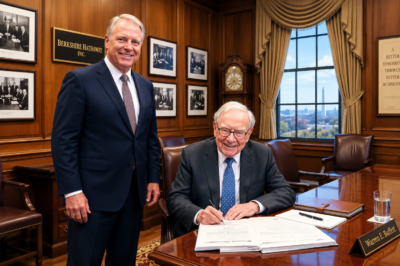
For more than five decades, Warren Buffett has been one of the most influential figures in global investing. Through Berkshire Hathaway, he built a corporate culture centred on patience, disciplined capital allocation, decentralised management and long-term value creation. His planned transition therefore represents far more than a change at the top—it marks the beginning of a carefully prepared new chapter for one of the world’s most closely watched companies.
Under the succession framework described in the supplied material, Howard G. Buffett is set to serve as non-executive Chairman, while Greg Abel assumes responsibility for the company’s operational leadership. The separation is designed to create a clear distinction between governance and day-to-day management, while preserving the principles that have shaped Berkshire Hathaway for generations.
Howard Buffett as Guardian of Berkshire’s Culture
Howard Buffett brings a background that differs considerably from traditional corporate leadership. A farmer, philanthropist and former sheriff, he has served on Berkshire Hathaway’s board for decades. His prospective role is less about investment decisions and more about protecting the company’s institutional culture.
Berkshire’s distinctive model gives considerable independence to the managers of its individual businesses. Maintaining that decentralised structure, high ethical standards and long-term orientation will be among the key responsibilities associated with the chairmanship.
Greg Abel and the Operational Challenge
While Howard Buffett is positioned as a guardian of the company’s values, Greg Abel will face the demanding task of running Berkshire’s vast collection of businesses and making major capital-allocation decisions.
The post-Warren era will test whether Berkshire can continue to deploy its substantial financial resources with the same discipline that became synonymous with Buffett’s leadership. The challenge will be particularly significant as the company evaluates acquisitions, investments and opportunities across changing economic conditions.
A Test of Succession and Corporate Governance
The transition also represents an important experiment in corporate succession. Warren Buffett’s extraordinary personal reputation has long been closely associated with Berkshire Hathaway. The new leadership structure must therefore demonstrate that the company’s strength rests not only on one individual, but also on its people, governance systems and underlying philosophy.
For investors and shareholders, the coming years will provide an opportunity to observe how successfully Berkshire maintains its decentralised culture, financial discipline and long-term approach without its legendary chairman at the centre.
A Legacy Moving Forward
The significance of this transition extends beyond one company. Berkshire Hathaway has become a case study in patient capital, corporate culture and long-term ownership. Howard Buffett’s role as Chairman and Greg Abel’s operational leadership represent an effort to preserve that legacy while allowing the organisation to evolve.
Warren Buffett may be stepping away from the centre of Berkshire Hathaway, but the principles developed during his extraordinary tenure are now being put to the ultimate test: whether a culture built around one remarkable leader can successfully become an enduring institution.






Leave a Reply