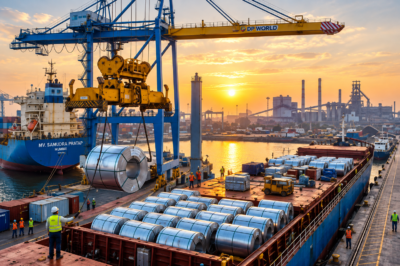
India’s steel industry has secured a significant opening in the European market with the allocation of a 1.64 million-tonne steel export quota by the European Union, marking an important development for the country’s global trade ambitions. Of the total allocation, around 6.95 lakh tonnes have been designated under the Free Trade Agreement (FTA) framework, offering Indian producers a preferential route into one of the world’s most important industrial markets.
The development comes at a time when international steel trade is facing mounting uncertainty, protectionist policies and tighter regulatory requirements. The EU’s steel safeguard regime, introduced in 2018, operates through tariff-rate quotas, with steel entering within specified limits receiving preferential treatment while quantities beyond the quota can attract a 25% safeguard duty.
For leading Indian producers such as Tata Steel, JSW Steel and ArcelorMittal Nippon Steel India, the enlarged market opportunity could provide greater export visibility and help strengthen their position in Europe. The quota covers different steel product categories and requires exporters to carefully coordinate production, shipments and quarterly allocations.
The 6.95-lakh-tonne FTA allocation is particularly significant. It provides Indian manufacturers with a preferential channel while encouraging greater focus on specialised and higher-value steel products. Such access could also strengthen long-term commercial relationships between Indian producers and European buyers.
Beyond exports, the agreement could generate wider economic benefits by supporting capacity utilisation, employment and foreign-exchange earnings. Exposure to demanding European quality standards may also encourage Indian manufacturers to invest further in advanced technologies and precision production.
However, the opportunity comes with an important challenge: decarbonisation. The EU’s Carbon Border Adjustment Mechanism (CBAM) is set to place increasing importance on the carbon footprint of imported steel. Indian producers will therefore need to accelerate investments in green steelmaking, recycling, hydrogen technologies and other low-carbon solutions.
The latest quota can therefore be viewed not simply as an export advantage, but as a strategic opportunity for India to strengthen its role in global steel supply chains. With the right combination of competitive production, technological modernisation and environmental preparedness, Indian steel could emerge as an increasingly important partner for Europe in the years ahead.






Leave a Reply