
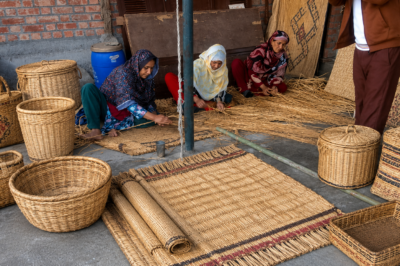
From humble reeds and paddy straw to an eco-conscious lifestyle product, the revival of Waggu is bringing a remarkable Kashmiri craft tradition back into the spotlight.
Srinagar: In the quiet marshlands of Kashmir, a remarkable story of tradition, resilience and renewal is taking shape. Known as Waggu, Wagoo or Vagu, the traditional Kashmiri mat—crafted from natural reeds, grass and paddy straw—is emerging from the shadows of declining use and finding new relevance in an increasingly sustainability-conscious world.
For generations, Waggu was a familiar presence in Kashmiri households, religious spaces and community settings. Made entirely from locally available natural fibres, the craft reflects the ingenuity of artisans who transformed simple vegetation into durable, functional and aesthetically distinctive floor coverings.
A Craft Woven with Patience
The making of Waggu is far from a simple process. Reeds and grass are collected from marshy areas, carefully dried and sorted, and then woven manually using traditional techniques. According to the account associated with the craft’s revival, two artisans may take around four days to complete a single mat.
Every stage—from selecting the raw material to weaving and finishing—requires experience and patience. The result is a lightweight natural product that carries the imprint of the artisan’s hand.
Beyond its utility, Waggu is valued for its natural characteristics. Traditionally, the mats have been appreciated for providing coolness during summer and warmth during winter, making them well suited to Kashmir’s local lifestyle and climate.
From Decline to Revival
Like many traditional crafts, Waggu faced a gradual decline as changing lifestyles, modern alternatives and shifting consumer preferences reduced its presence in everyday life.
Yet the story did not end there.
The efforts of Ghulam Hussain Ji of Srinagar and his daughter, Tanzila Ji, have brought renewed attention to the craft. Despite challenges, their determination to preserve the traditional art of Waggu helped generate wider interest and encouraged others to participate in its revival.
Their journey demonstrates that the survival of a traditional craft often depends not only on markets, but also on individuals willing to carry inherited knowledge forward.
Prime Minister’s Recognition Gives the Craft a National Spotlight
The revival received significant national attention when Prime Minister Narendra Modi highlighted Kashmir’s traditional Vagu mat during the 136th episode of Mann Ki Baat on 26 July 2026.
The Prime Minister appreciated the efforts of Ghulam Hussain Ji and his daughter in reviving the declining tradition and described Vagu as an eco-friendly product made from reeds and paddy straw. He also highlighted the traditional process of collecting, drying, sorting and hand-weaving the material.
The recognition has the potential to provide fresh momentum to the craft by bringing it before a much wider audience and connecting its traditional identity with the broader “Vocal for Local” movement.
Waggu Meets the Global Sustainable Lifestyle Market
Perhaps the most exciting chapter in Waggu’s story is its potential beyond the traditional mat.
With contemporary design intervention, the same natural weaving techniques can be adapted to create yoga mats, laundry baskets, table mats, runners, storage baskets, wall décor and other utility and lifestyle products.
There is also growing interest in natural-fibre products among international consumers looking for alternatives to synthetic materials. Some exporters are already exploring overseas markets with Waggu-based products, opening possibilities for the craft to evolve from a local household necessity into a commercially viable lifestyle category.
Its natural-fibre composition, handcrafted character and sustainable appeal could become major selling points in premium domestic and international markets.
Design, Branding and Market Access Hold the Key
The revival of Waggu, however, will require more than nostalgia. Design development, improved finishing, quality standardisation, attractive packaging, branding, digital marketing and stronger market linkages can determine whether the craft achieves long-term commercial sustainability.
Product diversification can also help artisans reach younger consumers who may not necessarily purchase a traditional floor mat but could be attracted to contemporary home décor, wellness and utility products made from natural fibres.
Training programmes and design workshops could further help artisans experiment with sizes, patterns, colour combinations and product categories without compromising the traditional identity of Waggu.
More Than a Mat
The story of Waggu ultimately goes beyond handicrafts and commerce. It is about preserving traditional knowledge while creating new economic possibilities for artisan communities.
A craft once associated primarily with everyday household use can now become part of the global conversation on sustainability, handmade products and responsible consumption.
The journey of Ghulam Hussain Ji and Tanzila Ji offers an important lesson: heritage does not have to remain frozen in the past. With innovation, institutional support and access to markets, traditional craftsmanship can evolve while retaining its cultural soul.
Waggu is more than a floor covering. It is Kashmir’s story of natural resources transformed by human hands—a story of heritage, resilience and renewal. And as the world searches for more sustainable ways of living, this humble Kashmiri craft may have found a new place on the global stage.




Leave a Reply