
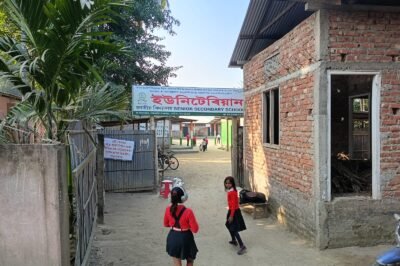
A recent government report has revealed a significant drop in school enrolment across India, with over 1 crore fewer students enrolled in the academic year 2023-24 compared to previous years. The alarming trend reverses earlier progress in education access and raises concerns about the challenges facing the education sector, including affordability, migration, and learning losses exacerbated by the pandemic.
Historical Trends in School Enrolment
India’s school enrolment figures have historically been a point of focus for policymakers, reflecting the nation’s efforts to improve literacy and education access.
- In 2018-19, total enrolment was recorded at 26.02 crore, showing a steady increase over the years.
- By 2019-20, enrolment rose by 1.6% to 26.45 crore, an increase of over 42 lakh students.
- The pandemic years saw fluctuations, with a slight dip in 2020-21 followed by a marginal recovery in 2021-22, when enrolment rose by 0.76%.
- Despite these fluctuations, the enrolment figures remained above 26 crore until the sharp decline reported in 2023-24.
The recent decline, bringing the total enrolment below 25 crore, marks a significant setback and calls for urgent intervention.
Factors Contributing to Decline
The drop in school enrolment can be attributed to several factors:
- Economic Pressures:
- Post-pandemic economic challenges have forced many families, especially in rural and low-income urban areas, to prioritize immediate income over education, leading to increased dropout rates.
- Learning Loss and Migration:
- School closures during the pandemic resulted in significant learning losses, discouraging students from continuing their education.
- Migration of families in search of better livelihoods disrupted the continuity of education for many children.
- Affordability Issues:
- Rising costs of education, including private school fees and associated expenses, have placed a burden on families, pushing children out of school.
- Digital Divide:
- While online learning provided a temporary solution during school closures, limited access to digital tools and the internet left many students, particularly in rural areas, unable to keep up.
Implications of Declining Enrolment
The drop in enrolment has far-reaching consequences for India’s socio-economic development:
- Increased Inequality: The decline disproportionately affects marginalized communities, widening existing gaps in educational access and opportunities.
- Future Workforce Challenges: A reduction in the number of educated individuals entering the workforce could impact India’s long-term economic growth and competitiveness.
- Social Impacts: Higher dropout rates are often linked to issues like child labor, early marriages, and reduced empowerment, particularly for girls.
Government and Policy Responses
Recognizing the urgency of the situation, the government has initiated efforts to address the decline in school enrolment:
- Schemes to Promote Enrolment: Programs like Samagra Shiksha Abhiyan aim to improve infrastructure, teacher training, and incentives to encourage children to return to school.
- Digital Learning Expansion: Efforts are underway to bridge the digital divide by providing affordable devices and internet access in rural areas.
- Focus on Affordability: State governments are exploring measures like subsidized school fees and scholarships to ease the financial burden on families.
Despite these efforts, experts argue that more comprehensive measures, including community engagement and targeted interventions, are needed to address the root causes of the decline.
Conclusion
The sharp decline in school enrolment in 2023-24 is a wake-up call for policymakers and educators. Addressing the issue requires a multi-faceted approach that prioritizes economic stability, accessibility, and equity in education. With India’s future tied closely to the education of its youth, reversing this trend is essential for the nation’s progress. By investing in innovative solutions and community-driven strategies, India can ensure that no child is left behind in its journey toward inclusive development.







Leave a Reply