
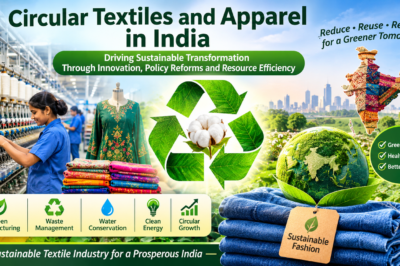
Advancing resource efficiency, green manufacturing, employment generation and global competitiveness through a circular economy
Introduction: A new direction for India’s textile and apparel industry
India’s textile and apparel sector represents one of the country’s most enduring economic strengths, combining traditional craftsmanship, agricultural resources, industrial capabilities, skilled manpower and a vast domestic market. From cotton cultivation and handloom weaving to spinning, processing, garment manufacturing, technical textiles and fashion retail, the sector encompasses an extensive value chain that supports millions of livelihoods and contributes substantially to manufacturing, exports and economic development.
However, the traditional model of production and consumption—based on extracting resources, manufacturing products, consuming them and ultimately discarding them—is increasingly becoming unsustainable. Rising pressure on natural resources, water scarcity, pollution, energy consumption, chemical discharge and growing textile waste have made it essential to rethink the manner in which textiles are designed, manufactured, marketed, used and disposed of.
In this context, the concept of a circular economy offers an important opportunity to transform India’s textile and apparel industry. It promotes a system in which resources remain in productive use for as long as possible through reduction, reuse, repair, refurbishment, recycling and regeneration. Rather than treating waste as an unavoidable by-product, circularity recognises it as a potential resource for new products, enterprises and employment opportunities.
The report Circular Textile and Apparel in India: Policy Intervention Priorities and Ideas, prepared by the Centre for Responsible Business in April 2022, provides a comprehensive assessment of the sector and identifies policy priorities through consultations with industry, manufacturers, brands, chemical companies, academic institutions, innovators and government representatives. Its central message is that circularity should not be viewed merely as an environmental obligation; it is also an opportunity to improve productivity, strengthen competitiveness, generate employment and secure India’s position in evolving global value chains.
- India’s textile sector: Economic strength and employment potential
The textile and apparel industry occupies a significant position in India’s economic and industrial landscape. According to the 2022 report, the sector contributed approximately 2 per cent to India’s GDP and around 18 per cent of manufacturing output in 2017–18. It was described as one of the country’s largest employment-generating sectors, providing direct employment to approximately 45 million people and indirect employment to another 60 million in allied activities, based on the cited Economic Survey 2019–20 estimates.
The sector’s importance extends well beyond conventional textile manufacturing. Its activities support cotton and other natural-fibre farmers, yarn producers, weavers, dyers, processors, garment manufacturers, designers, retailers, transporters and numerous small enterprises. The industry also has strong linkages with agriculture, chemicals, engineering, logistics, packaging, fashion, tourism and international trade.
India possesses an extensive domestic textile value chain and abundant resources, including cotton, silk, jute and wool. Its traditional capabilities in weaving, embroidery, printing, dyeing and other crafts provide a distinctive competitive advantage. The country is also well positioned to expand into technical textiles, recycled fibres, sustainable fashion and innovative textile products.
The report highlighted that India’s textile and apparel exports were substantially connected to international markets, particularly the United States and the European Union. It also noted that the industry had considerable potential to benefit from global demand for sustainable products, provided that manufacturers improved quality, resource efficiency, traceability and environmental performance.
The employment multiplier of the sector, cited in the report as 5.172, further illustrates its potential to stimulate economic activity across interconnected industries. Consequently, a transition towards circularity can generate employment not only in manufacturing but also in collection, sorting, repair, refurbishment, recycling, product redesign and waste management.
- Understanding the circular economy: From a linear model to a regenerative system
A circular economy is an economic model designed to retain the value of products, materials and resources for the longest possible period. It seeks to minimise waste and pollution, maintain products and materials in circulation and contribute to the regeneration of natural systems.
The report identifies three fundamental principles:
- Design out waste and pollution: Products and production processes should be designed to minimise waste, harmful chemicals, excessive water consumption and unnecessary energy use.
- Keep products and materials in use: Textiles and garments should be reused, repaired, refurbished, recycled and repurposed rather than discarded prematurely.
- Regenerate natural systems: Production should increasingly rely on sustainable materials, cleaner energy, responsible water management and environmentally sound agricultural practices.
For the textile industry, circularity must cover the entire value chain—from fibre cultivation and raw-material procurement to spinning, weaving, knitting, dyeing, finishing, garment production, packaging, retail, consumer use and end-of-life recovery.
This integrated approach is particularly important for India because the industry is highly decentralised and comprises numerous micro, small and medium enterprises. Individual units may lack the financial resources, technical expertise and infrastructure required to independently adopt advanced environmental technologies. Cluster-based solutions, shared facilities, institutional support and coordinated policy interventions are therefore essential.
- Structural challenges affecting the sector
Despite its considerable strengths, the Indian textile and apparel industry faces several structural constraints that affect productivity, exports, technological development and international competitiveness.
Fragmented industrial structure: A substantial proportion of Indian textile enterprises operate on a small or medium scale, with spinning, weaving, processing and garment manufacturing frequently undertaken by separate units. This fragmented structure restricts economies of scale, coordinated production, technology adoption and collective waste management.
Limited technological modernisation: Several small and cooperative units continue to operate with outdated machinery and inefficient production processes. This affects product quality, productivity, energy efficiency and the ability to meet increasingly demanding international standards.
High input and production costs: The report identifies the cost of raw materials, capital, land and labour as important competitive challenges. High input costs can reduce the advantages of India’s manufacturing capabilities and affect its position against competing textile-producing countries.
Limited product diversification: The industry has historically maintained considerable dependence on cotton-based products. Greater attention is required towards man-made fibres, recycled materials, technical textiles, innovative fabrics and value-added products that respond to changing international demand.
Dependence on limited export markets: Concentration in particular overseas markets exposes manufacturers to economic fluctuations, geopolitical developments, changing trade requirements and variations in consumer demand.
Inadequate waste-management systems: Textile waste generated during manufacturing and after consumer use is not consistently collected, segregated, processed and channelled back into production. This results in the loss of valuable materials and increased pressure on landfills.
Insufficient research and development: Cost-effective recycling technologies, sustainable alternatives to conventional fibres, green chemicals, waterless dyeing and resource-efficient machinery require stronger research support and wider commercial adoption.
These challenges demonstrate that circularity must be accompanied by industrial modernisation, improved institutional coordination, financial assistance and an enabling policy environment.
- Sustainable raw materials and responsible textile design
The selection of raw materials is one of the most important determinants of the environmental footprint of textile products. Cotton is a major input in India’s textile industry, but its cultivation can require substantial water and agricultural inputs. Synthetic fibres such as polyester present a different challenge because they are non-biodegradable and can release microplastic particles during washing.
The report therefore emphasises the need to diversify the material base and encourage the use of sustainable and recycled fibres. Hemp, banana fibre, bamboo, other cellulose-based materials and suitable recycled fibres offer opportunities for product innovation and resource conservation.
India’s traditional natural-fibre capabilities can be integrated with modern design, processing and marketing technologies to develop new product categories. Sustainable material sourcing can also create additional opportunities for farmers, rural enterprises, artisans and local manufacturing clusters.
However, a successful transition requires transparent information about fibre composition and material origin. Manufacturers and retailers should clearly disclose the content of textile products so that consumers can make informed choices and recycling facilities can identify appropriate processing methods.
Design must also consider durability, repairability, ease of dismantling, sorting and recycling. Collaboration between industry, designers and institutions such as the National Institute of Fashion Technology (NIFT) and the National Institute of Design (NID) can support the development of innovative designs, patterns and production techniques suited to circular manufacturing.
The report proposes that the Ministry of Textiles, in collaboration with relevant academic and technical institutions, develop industry guidelines for circular design and manufacturing. Such guidelines could establish benchmarks for material selection, production waste, chemical use, water and energy consumption, labelling and end-of-life recovery.
- Chemical management and environmentally responsible processing
Dyeing, bleaching, washing, printing and finishing are essential stages of textile production, but the use of hazardous chemicals and inadequate wastewater treatment can cause serious environmental damage.
The report observes that thousands of chemicals are used across the textile and apparel value chain and highlights the need for better monitoring, responsible chemical management and stronger compliance mechanisms.
The transition towards environmentally responsible processing should include:
- Monitoring and controlling the use of hazardous chemicals throughout manufacturing.
- Promoting natural dyes and safer chemical alternatives.
- Encouraging waterless and low-water dyeing technologies, including foam-based, digital and supercritical carbon dioxide-based processes.
- Strengthening verification of Material Safety Data Sheets and restricted-substance requirements.
- Improving wastewater treatment and compliance with prescribed discharge standards.
- Encouraging research into green chemicals and less polluting finishing technologies.
The report recommends coordinated action by the Central Pollution Control Board, State Pollution Control Boards, local authorities and the Ministry of Environment, Forest and Climate Change, along with the Ministry of Textiles.
Greater adoption of natural dyes and traditional dyeing knowledge, supported by scientific testing and standardisation, could also create new opportunities for craft-based enterprises and sustainable textile products.
- Textile waste management: Converting waste into economic value
One of the most important opportunities in a circular textile economy is the recovery and productive use of textile waste.
The report identifies three major categories of textile waste:
Pre-consumer waste: Generated during fibre processing, yarn and fabric production, cutting, stitching and garment manufacturing. It includes fabric off-cuts, rejected material, selvages and production residues.
Post-consumer waste: Garments and household textiles that consumers no longer use or that are no longer suitable for their original purpose.
Industrial textile waste: Materials such as carpets, curtains, upholstery and other textile products discarded after commercial or industrial use.
Instead of allowing these materials to reach landfills, a structured system should be developed for collection, segregation, sorting, repair, reuse, upcycling and recycling.
The report proposes several measures:
- Conducting systematic waste audits in textile and apparel clusters to identify the nature and quantity of waste.
- Developing common waste collection, sorting and processing facilities.
- Establishing digital exchanges through which enterprises can trade surplus material and recoverable waste.
- Linking smaller manufacturers with recyclers and upcyclers.
- Strengthening reverse logistics and collection networks.
- Encouraging brands and retailers to introduce garment take-back programmes.
- Exploring Extended Producer Responsibility (EPR) mechanisms for the apparel sector.
- Supporting government-funded research into cost-effective textile recycling technologies.
The integration of waste collectors and processors into organised systems is equally important. Many activities relating to collection, sorting, repair and reuse can create livelihood opportunities for informal workers and small entrepreneurs. Their participation should be supported through training, safer working conditions, institutional recognition and appropriate access to markets.
A well-organised textile waste ecosystem can therefore convert an environmental challenge into a productive economic activity while reducing dependence on virgin raw materials.
- Energy efficiency and renewable energy
Textile manufacturing involves several energy-intensive processes, particularly spinning, weaving, processing and finishing. The report identifies the need to modernise machinery and improve energy efficiency, especially among MSMEs and cooperative units.
The adoption of energy-efficient equipment, cleaner fuels, renewable energy and improved production practices can reduce operating costs and environmental impacts.
Important measures include:
- Encouraging renewable energy use in textile and apparel clusters.
- Promoting solar and other suitable clean-energy systems.
- Supporting modernisation of outdated machinery.
- Providing stable and predictable policies for investment in renewable energy.
- Promoting energy audits and resource-efficiency assessments.
- Encouraging small-scale technological innovations that can be adopted by MSMEs.
- Documenting successful innovations and replicating them in other industrial clusters.
The report specifically recognises that small, practical innovations can deliver meaningful results. It cites examples of on-site bioremediation facilities in Ahmedabad and Vadodara as promising approaches for effluent treatment and resource management.
Such interventions demonstrate that sustainability does not always require large industrial investments; suitable local technologies and shared infrastructure can also produce substantial improvements.
- Water conservation and wastewater recycling
Water is indispensable to textile manufacturing, particularly in dyeing, washing, bleaching and finishing. Excessive consumption, groundwater depletion and untreated wastewater discharge pose serious challenges to the industry’s long-term sustainability.
The report identifies water audits, recycling systems, modernisation of processing facilities and common effluent treatment infrastructure as important priorities.
The proposed measures include:
- Conducting water audits to measure consumption and identify opportunities for conservation.
- Encouraging the use of recycled water in textile and garment manufacturing.
- Modernising dyeing and processing units to reduce water requirements.
- Prioritising the upgrading of existing facilities that do not adequately treat wastewater.
- Establishing common effluent treatment and shared infrastructure for smaller units.
- Developing cluster-specific wastewater standards and monitoring mechanisms.
- Providing incentives to enterprises adopting water-efficient machinery and recycling technologies.
The Tirupur–Coimbatore cluster provides an important example of the potential of collective water-management systems. As documented in the report, the cluster achieved 100 per cent Zero Liquid Discharge, with approximately 95 per cent water recycling and reuse and 99 per cent salt recovery. The Bawana common effluent treatment facility was also cited as an example, with an actual efficiency rate of around 90 per cent and water reuse of approximately 85 per cent.
These documented examples demonstrate that coordinated infrastructure and technological intervention can substantially reduce industrial water pollution and conserve valuable resources.
- Existing initiatives and achievements: India’s progress towards circularity
The April 2022 report documents several initiatives undertaken by textile companies and industrial clusters. These examples illustrate that circular economy principles are not merely theoretical; practical interventions are already being adopted in different segments of the Indian textile value chain.
Tirupur–Coimbatore: Water recycling and Zero Liquid Discharge
The knitwear and dyeing cluster has demonstrated the potential of collective wastewater management. The report records 100 per cent Zero Liquid Discharge, approximately 95 per cent water recycling and reuse, and 99 per cent salt recovery. This represents an important achievement in the adoption of common environmental infrastructure.
Bawana: Common wastewater treatment
The Bawana industrial facility demonstrates the contribution of common effluent treatment systems to water recovery and reuse. The report records an actual treatment efficiency of around 90 per cent and a water-reuse rate of approximately 85 per cent.
Aditya Birla Fashion and Retail Limited: Sustainable value-chain practices
The report identifies initiatives covering sustainable cotton procurement, resource-efficient manufacturing, environmental management, traceability, water and energy conservation, sustainable packaging, product durability and take-back programmes. It also records the company’s association with the Sustainable Apparel Coalition and its use of blockchain technology for transparency and traceability.
Arvind Limited: Resource-efficient manufacturing
Arvind Limited is cited for innovation in material processing and manufacturing, reduction of material wastage, energy efficiency, sustainable sourcing, zero-waste discharge initiatives and the promotion of reuse and recycling. The report also refers to its support for farmers engaged in organic procurement.
Alok Industries Limited: Sustainable sourcing and technological innovation
The report highlights technical support to farmers for organic and sustainable raw materials, technological upgradation, improved water and energy efficiency and initiatives for waste reuse and recycling. It also identifies the company’s farmer-owned Fairtrade-certified enterprise model as a notable development.
Levi Strauss (India): Denim recycling and water-efficient processing
The report records participation in the Better Cotton Initiative and the Cotton Incorporated Blue Jeans Go Green denim recycling programme, along with initiatives relating to refurbishment, recycling, resource efficiency and waterless dyeing.
Raymond Industries Limited: Recycled materials and sustainable fabrics
The report highlights the development of fabric using recycled PET bottles in collaboration with Reliance Industries Limited. It also records initiatives relating to durable fabrics, recycling and refurbishment, organic raw-material sourcing, recycled-water use in manufacturing plants and alternative energy sources.
Taken together, these examples demonstrate the growing participation of Indian textile enterprises in resource conservation, recycling, sustainable sourcing and environmental management. They also provide practical models that can be studied, documented and adapted by other industrial clusters, particularly MSMEs.
- Technical textiles: A strategic opportunity for circular innovation
Technical textiles represent an important emerging segment because they are designed primarily for functional applications rather than aesthetic purposes. Their use extends to agriculture, healthcare, construction, automobiles, infrastructure, industrial safety, packaging and personal protection.
The report identifies twelve major technical textile categories, including Agrotech, Meditech, Buildtech, Mobiltech, Clothtech, Oekotech, Geotech, Packtech, Hometech, Protech, Indutech and Sportech.
Although India consumes a wide range of technical textiles, the report notes that domestic production was concentrated in selected segments, while dependence on imports remained high for several specialised products.
The sector offers considerable scope for circularity because a large proportion of technical textiles are based on man-made fibres, creating opportunities for recovery and recycling.
Some important areas identified in the report include:
- Recycling of used protective clothing, masks, firefighting garments and other personal protective equipment.
- Recovery and recycling of fishing nets and agricultural nets.
- Conversion of post-consumer cotton textiles into pulp and cellulosic fibres.
- Recovery of PET bottles for conversion into polyester fibre.
- Development of sustainable alternatives to conventional plastic-based products.
- Better collection systems for HDPE and other recoverable materials.
- Improved labelling and regulation of biodegradable and compostable products.
- Development of green chemicals for coatings and technical textile processing.
The report also stresses that technical textiles require stronger research and development, quality standards, testing facilities, collection systems and end-of-life management procedures.
The National Mission on Technical Textiles and the development of Centres of Excellence, research institutions and testing facilities provide an institutional foundation for expanding domestic capabilities. Greater collaboration between industry, research institutions and start-ups can help India develop high-value, sustainable technical textile products and reduce import dependence.
- Strengthening research, technology and institutional collaboration
The successful adoption of circular practices requires a strong research and development ecosystem. The report identifies several government-funded research organisations, Centres of Excellence and academic institutions that can contribute to innovation in materials, manufacturing, processing and recycling.
Institutions such as NITRA, SITRA, SASMIRA, AITRA, BTRA, the Wool Research Association and other specialised research organisations have an important role in developing technologies suitable for Indian industrial conditions.
Academic and technical institutions, including IITs, NIFT, NID and engineering universities, can collaborate with manufacturers and designers to develop sustainable products, production systems and industry-oriented training programmes.
Priority areas for research include:
- Alternative natural and recycled fibres.
- Cost-effective mechanical and chemical recycling.
- Separation and recovery of blended fibres.
- Waterless dyeing and water-saving technologies.
- Natural dyes and environmentally safer chemicals.
- Advanced wastewater treatment and reuse.
- Energy-efficient machinery.
- Sustainable technical textiles.
- Digital traceability and material identification.
A comprehensive technology compendium should also be developed to provide MSMEs with accessible information about available technologies, their costs, benefits and suitability for different manufacturing processes.
- Skill development, employment and protection of traditional livelihoods
A circular transition must be people-centred. It should not focus exclusively on environmental performance or industrial productivity while overlooking the workers, farmers, artisans and small enterprises whose livelihoods depend on the textile value chain.
The transition will create demand for new skills in textile sorting, material recovery, repair, refurbishment, redesign, recycling, sustainable processing and resource management. Existing workers will require appropriate training to adapt to changing production technologies and market requirements.
The report emphasises that skill-development programmes should be aligned with the actual requirements of industry. Training institutions and industry associations should jointly identify skill gaps and develop practical, employment-oriented courses.
The transition must also safeguard workers whose livelihoods may be affected by changes in raw materials or production systems. For example, a shift away from conventional cotton towards alternative fibres could affect cotton farmers and related activities. Appropriate support, awareness, market linkages and income opportunities must therefore accompany the adoption of sustainable materials.
India’s traditional textile and handicraft sectors deserve particular attention. Handloom weavers, artisans, natural-dye practitioners, embroidery workers and traditional textile producers already possess knowledge of local materials, repair, reuse and resource-conscious production. Integrating this knowledge with contemporary design, quality standards, technology and market access can strengthen their economic position.
Repair, refurbishment, upcycling and reuse also offer opportunities for self-employment, women-led enterprises, producer groups, cooperatives and community-based businesses. A socially responsible circular economy can therefore support both environmental improvement and inclusive livelihood generation.
- Sustainable public procurement and responsible consumer participation
Government procurement can become an important instrument for creating demand for sustainable textile products. The report recommends that public authorities consider environmental and social criteria while procuring uniforms, workwear and other textile materials for government departments and public institutions.
Products made from recycled fibres, recovered textile waste and environmentally responsible materials can be encouraged through transparent procurement specifications and platforms such as Government e-Marketplace (GeM), subject to applicable quality and procurement requirements.
Such procurement can create a predictable market for sustainable manufacturers and encourage investment in greener production technologies.
Consumer awareness is equally important. Brands, retailers, educational institutions, civil society organisations and government agencies can promote responsible consumption by encouraging consumers to:
- Purchase durable and responsibly manufactured products.
- Repair and reuse garments wherever possible.
- Donate or return unwanted clothing through organised collection systems.
- Prefer products with transparent material and sustainability information.
- Avoid unnecessary disposal and excessive consumption.
A strong partnership between manufacturers, brands, consumers and public institutions is necessary to establish a functioning circular textile ecosystem.
- Policy and institutional reforms: The road ahead
The report makes clear that isolated initiatives will not be sufficient to transform a fragmented and resource-intensive industry. A coordinated policy framework led by the Ministry of Textiles is required to align industrial development with environmental sustainability and social objectives.
The principal policy priorities include:
A national circular textile roadmap: The Ministry of Textiles should develop a comprehensive roadmap in consultation with manufacturers, exporters, brands, research institutions, industry associations, civil society organisations and other relevant ministries.
Circular design and manufacturing standards: Industry guidelines should establish parameters for material selection, production waste, chemical consumption, water and energy efficiency, product durability, labelling and recyclability.
Extended Producer Responsibility: Appropriate EPR mechanisms and reverse-logistics arrangements should be explored to ensure that post-consumer textiles are collected and channelled towards reuse and recycling.
Cluster-based common infrastructure: Textile clusters should be supported through shared facilities for wastewater treatment, waste collection, sorting, recycling, renewable energy and digital exchange of surplus materials.
Financial and fiscal incentives: Targeted incentives, credit support and technology-upgradation assistance should encourage MSMEs to adopt sustainable machinery, alternative fibres, water recycling and clean-energy systems.
Research and innovation: Public research institutions, academic bodies, start-ups and manufacturers should receive support for developing cost-effective recycling and resource-efficiency technologies.
Chemical and wastewater regulation: Monitoring, treatment and discharge standards should be strengthened in coordination with environmental regulatory authorities and local bodies.
Sustainable procurement and labelling: Public procurement guidelines, product-content disclosure and quality standards for recycled materials should encourage responsible production and build consumer confidence.
Skill development and just transition: Workers, artisans, farmers and entrepreneurs should receive training and institutional support so that the transition creates new employment opportunities without unnecessarily displacing existing livelihoods.
Monitoring and measurable outcomes: The sector should establish indicators for water consumption, energy efficiency, waste reduction, recycling, chemical management, emissions, employment and worker welfare. Regular cluster-level audits and public reporting can help measure progress and improve accountability.
Conclusion: Building a globally competitive and environmentally responsible textile future
India stands at an important juncture in the evolution of its textile and apparel industry. Its traditional strengths in natural fibres, handlooms, handicrafts, skilled craftsmanship and manufacturing capabilities provide a strong foundation for building a sustainable and globally competitive textile economy.
The transition from a linear to a circular production system is not simply a matter of introducing recycling technologies. It requires a comprehensive transformation in the way raw materials are sourced, products are designed, manufacturing processes are managed, waste is recovered, workers are trained and markets are developed.
The achievements documented in the CRB report—particularly the water-recycling initiatives at Tirupur–Coimbatore and Bawana, and the sustainability practices of companies such as Aditya Birla Fashion and Retail, Arvind, Alok Industries, Levi Strauss and Raymond—demonstrate that meaningful progress is possible when industry commitment is supported by technology, research and institutional cooperation.
The next phase must focus on taking such initiatives beyond individual enterprises and extending them across industrial clusters, MSMEs, traditional craft communities and the wider textile value chain. Stronger research, common infrastructure, sustainable financing, responsible procurement, digital traceability and effective skill development will be essential to achieve this objective.
Most importantly, India’s circular textile transition must be inclusive. Farmers, artisans, weavers, workers, women entrepreneurs, waste collectors, designers and small manufacturers must all become participants and beneficiaries of the transformation.
By combining traditional knowledge with modern technology, responsible production with innovative design, and environmental protection with economic opportunity, India can develop a textile and apparel ecosystem that is resource-efficient, employment-oriented and globally respected.
A truly circular textile economy will not merely reduce waste; it will create value from resources, strengthen livelihoods, preserve traditional capabilities, encourage innovation and contribute to a more sustainable and prosperous India.






Leave a Reply