
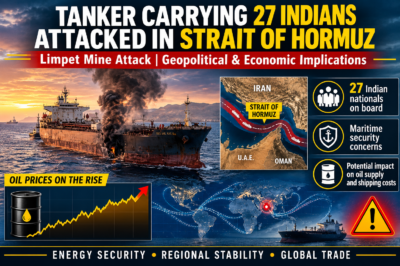
The Strait of Hormuz, one of the world’s most strategically important maritime routes, has once again come under focus following a reported attack on a commercial tanker carrying 27 Indian nationals. The suspected use of limpet mines, magnetic explosives attached to a vessel’s hull, has raised serious concerns about the safety of merchant ships and the security of global energy supplies.
Limpet mines can be placed by divers or small boats and are capable of causing significant damage to a ship’s outer hull. The reported incident highlights the vulnerability of commercial vessels operating in politically sensitive waters, where maritime activities can become entangled in wider regional tensions. The safety of the 27 Indian crew members has consequently emerged as a major concern for India.
The Strait of Hormuz is a critical passage for international oil shipments, connecting the Persian Gulf with the Gulf of Oman. Any threat to navigation through this narrow waterway can affect global energy markets, increase crude oil price volatility and raise shipping and insurance costs. The possibility of supply disruptions also has implications for countries such as India, which depend significantly on energy imports from the region.
The incident has renewed attention on India’s maritime security measures, particularly Operation Sankalp, launched by the Indian Navy in 2019 to facilitate the safe passage of Indian-flagged vessels in the Gulf region. Enhanced surveillance, naval coordination and diplomatic engagement remain important components of protecting Indian seafarers and commercial shipping.
The attack also underlines the need for international cooperation to safeguard vital maritime routes and prevent commercial vessels from becoming targets of geopolitical disputes. A thorough investigation, protection of seafarers and continued efforts to maintain freedom of navigation will be essential to reducing risks in the region. For India, the incident reinforces the importance of safeguarding its maritime interests, ensuring the security of its nationals and diversifying energy supply routes.





Leave a Reply