
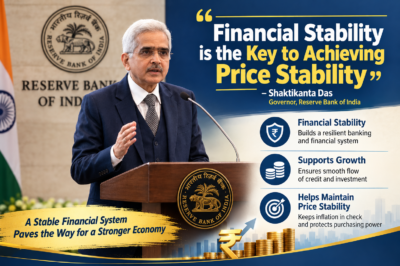
In an increasingly interconnected global economy marked by geopolitical tensions, fluctuating commodity prices and financial uncertainties, the Reserve Bank of India (RBI) has emphasised the close relationship between financial stability and price stability. Former RBI Governor Shaktikanta Das highlighted that both are essential for maintaining economic confidence, protecting purchasing power and ensuring sustainable growth. A resilient financial system enables monetary policy to function effectively, while stable prices support investment, consumption and long-term economic planning.
Interdependence of Financial and Price Stability
The RBI’s monetary policy framework aims to maintain price stability while keeping economic growth in view. Inflation management becomes more difficult when banks face mounting bad loans, liquidity shortages or weaknesses in the non-banking financial sector. Under such circumstances, changes in policy interest rates may not be transmitted effectively to businesses and consumers. Similarly, persistent inflation can weaken household purchasing power and create financial stress for borrowers and lending institutions.
Managing Global Economic Uncertainties
International interest-rate movements, crude oil price fluctuations and volatile capital flows can affect India’s currency, import costs and domestic inflation. To address these challenges, the RBI relies on foreign exchange reserves, financial-sector supervision and stress testing to strengthen the economy’s ability to withstand external shocks.
Strengthening Banks and NBFCs
Commercial banks and Non-Banking Financial Companies (NBFCs) play a crucial role in providing credit to businesses and individuals. Strong capital positions, improved asset quality and effective regulation help safeguard financial stability. At the same time, the RBI has expressed concern about rapid growth in unsecured retail lending and has adopted regulatory measures to limit the accumulation of excessive credit risks.
Inflation Control and Technological Innovation
The central bank continues to address inflationary pressures arising from food prices, weather conditions and supply-chain disruptions. Transparent communication and credible inflation targets help manage public expectations. Meanwhile, supervisory technology, artificial intelligence and machine learning can strengthen financial monitoring. Secure digital payment systems, responsible financial innovation and carefully regulated digital currency initiatives are also important components of a resilient financial ecosystem.
Conclusion
Financial stability and price stability must advance together to support India’s long-term economic ambitions. Effective regulation, prudent lending, technological resilience and proactive risk management can strengthen public confidence and protect the economy against uncertainty. By maintaining a balanced approach to inflation control and financial-sector stability, the RBI can help create favourable conditions for investment, employment generation and sustained economic development.







Leave a Reply